
Fluid Spacetime Omni-Theory (FSOT)
A Cross-Domain Theory of Everything — Published on GitHub
Author: Damian Arthur Palumbo
Repository: github.com/dappalumbo91/FSOT-2.1-Lean
Edition: v2.13 — living gauntlet lock · 2026-09-29
Status: Living thesis — Theory of Everything claim is explicit (see section below)
Live numbers: docs/CURRENT_STATUS.md · what the numbers mean: docs/COUNT_VOCABULARY.md · kill-command map: docs/EMPIRICAL_CLAIM_EVIDENCE.md
New here? → docs/START_HERE.md · Scientist read → docs/SCIENTIST_INTERFACE.md · Concepts → docs/CONCEPTS.md · Directory → docs/SYSTEM_DIRECTORY.md · Apply → docs/APPLY.md
Live scoreboard — three ledgers (regenerate: python scripts/build_repo_status_snapshot.py)
Do not mix these. Spec: docs/LEDGERS.md · knobs: docs/FROZEN_KNOBS.md · misses: results/MISSES.md · not claimed: docs/WHAT_WE_DO_NOT_CLAIM.md
| Ledger | Verb | Live | Forbidden |
|---|---|---|---|
| A closed-form | predict (no measured in the formula) | python scripts/predict_closed_form.py --observable T_CMB then compare | quoting 477/477 as this |
| B catalog residual | correct (c=m(1+|S|f)) | Accuracy claim: 0 confirmed held-out. Exploratory 359,782 · frozen, pending 0 · confirmed held-out 0 · structural / identity 140,100. Scalar gate: 50,927 genuine predictions · 140,088 Ledger B corrections · recomputed 470 / 7 (stored-error 477 / 0). docs/EVIDENCE_TIERS.md | calling the exploratory count, the correction count, or 477/477 the confirmed accuracy |
| C live integrity | check pin / stream / hash | pin AEB2AD match · multiprover overall_ok | promoting C into A or B |
Pin is the SHA-256 prefix of vendor/fsot_compute.py (this edition AEB2AD — nest (D_{\mathrm{eff}}), derived observed/species, named _fold_C unused by (S), baryon/DM at Chemistry, decimals are (\pi) identities, (f=\alpha)). Full status: docs/CURRENT_STATUS.md.
The authority summary is 342 / 343 targets within 5%. Eight of the 342 are identity or definition rows. 334 are seed-derived. DNA_base_pair is in the 334 and uses the measured Bohr radius as an input. Gluon_condensate is the row outside 5%. The file is not edited here. Notes for the next deliberate re-pin: docs/AUTHORITY_REVISION_NOTES.md. Observables whose formula takes no measured input of the same dimension: docs/NO_MEASURED_INPUT.md. Preregistered rows are scored on their own in data/held_out_prereg_report.json and stay out of the green count. Evidence tiers, with confirmed held-out as the accuracy claim: docs/EVIDENCE_TIERS.md and data/evidence_tiers.json.
477 is green benchmark files. ~407 is named coverage-map domains. ~403 is atlas CSV rows. 2030 is live atomic obligations (full formal 2594, catalog 2205). Do not mix them. Ledger:
docs/COUNT_VOCABULARY.md.
Older prose saying 394/394, 405/405, 430/432, 433/433, 1,863 atomic, 57% Mathlib, or ~1912 obligations is stale.
git clone https://github.com/dappalumbo91/FSOT-2.1-Lean.git
cd FSOT-2.1-Lean
pip install -r requirements.txt
lake exe cache get
lake build FSOT
python scripts/run_mathlib_rederivation_campaign.py   # expect FULL_CORPUS_MATHLIB_CAMPAIGN_CLOSED
python scripts/run_formula_authority_closure.py       # expect FORMULA_AUTHORITY_SYSTEM_CLOSED
python scripts/audit_all_benchmark_margins.py         # expect green_gate_fail_count 0; read genuine_prediction_count and structural_correction_count
python scripts/evidence_tiers.py --check              # Tier 3 freeze date must precede the data release; accuracy claim is confirmed held-out
python scripts/run_publication_verification_bundle.py
Theory of Everything — what we claim (not hidden)
FSOT is put forward as a candidate Theory of Everything under a frozen technical checklist, not as a slogan.
| Label | Meaning | Status |
|---|---|---|
| Label A | Seed-locked multi-domain empirical framework (≤0.5% green gate, multi-prover, falsification registry) | PASS |
| Label B | Classical ToE criteria T1–T6 (ontology, dynamics, limit recovery, force/scope, prereg freeze, falsifiability) | PASS |
Frozen criteria: docs/TOE_CLAIM_BOUNDARIES.md
Gap runbook + scope honesty: docs/TOE_GAP_CLOSURE.md
Machine report: data/toe_gap_closure_report.json (label_A_empirical_framework: true, label_B_classical_toe: true)
What ToE PASS means here
- One seed-derived scalar engine (π, e, φ, γ, G / Catalan) — live pin AEB2AD (Paper 03 freeze remains D1D38A;
docs/PIN_LINEAGE.md) — no post-hoc fits; 35 folds frozen. - Continuum / fluid dynamics (
vendor/fsot_dynamics.py) + limit-recovery probes (GR weak field, QM scales, SM bridges). - Ledger B residual atlas green (live count in
docs/CURRENT_STATUS.md, ≤0.5% pooled) — not a Ledger A headline. - Contested-sector public anchors (H₀ Planck/SH0ES, DESI w_a, N_eff, σ₈, Higgs, …) with utilization fixes, not excuses.
Against the same public measurements, the external 2026-09-24 comparison has FSOT closer than Planck ΛCDM on three locks. N_eff = 3.046 matches the Standard Model value and does not discriminate.
| Lock | FSOT | Planck ΛCDM |
|---|---|---|
| H₀ vs CCHP | 70.75, 0.3σ | 67.4, 2.5σ |
| S₈ vs DES Y6 | 0.805, 1.3σ | 3.8σ |
| wₐ | −1.018, 2.2σ | 3.0σ |
Directional H₀ on Hubble-flow supernovae is a null, not a sector map. See docs/H0_DIRECTION_PRIORS.md.
5. Preregistered freeze + falsification registry.
6. Multi-prover triangulation (Lean master + Coq/Isabelle/F*/Rust + SMT + TLA+).
What remains (process — not a secret technical gap)
| Remaining | Role |
|---|---|
| Peer review (arXiv + journals) | Social/scientific acceptance path |
| Independent clean-clone reproduction | PASS on 2026-09-29: a clone of 95a1113 ran lake build FSOT and finished 2206 jobs, pin AEB2AD (report). The earlier Mathlib close also PASS (report). Harness: pwsh scripts/fresh_clone_repro.ps1 |
| Multiprover re-pass | PASS at 2026-09-29T22:05:48Z, overall_ok: true. Coq 49/49, Isabelle 46/46, F* passed, Lean connective passed, Rust replay 2130. QEMU passed. ESP32 was skipped, so eight-way hardware is false. Report: data/cross_proof_verification_report.json |
| Deeper T3/T4 research | Shipped: GR+SM force package + CKM/PMNS multi-prover (Lean/Coq/Isabelle/F*/Rust/SMT/TLA+) — docs/GR_SM_CKM_MULTIPROVER.md; uniqueness/QFT phases still open |
We are not hiding the ToE claim. We are separating technical Label B (closed under frozen T1–T6) from peer acknowledgment (open). Domain count and prover count strengthen Label A; they do not redefine Label B.
Mathlib depth + formula authority (this close)
| Gate | Verdict | Command |
|---|---|---|
| Full Formal Mathlib-class depth | 5248/5248 · 100% · L1=0 | python scripts/run_mathlib_rederivation_campaign.py |
| Campaign | FULL_CORPUS_MATHLIB_CAMPAIGN_CLOSED | same |
| Formula authority (pin · ZERO_FREE · residual · lake · depth) | FORMULA_AUTHORITY_SYSTEM_CLOSED | python scripts/run_formula_authority_closure.py |
| Clean clone (GitHub tip, no local patches) | PASS | Lean rebuild data/fresh_clone_lean_repro_report.md · Mathlib path data/fresh_clone_corpus_mathlib_repro_report.md |
Depth tiers are honest: L0 definitional · L2 analytic Mathlib · L3 constructive chains. Pure norm_num certificates (L1) were upgraded to L0/L3 without changing residual law or free parameters — same statements, stronger proof shape. Docs: docs/MATHLIB_REDERIVATION_CAMPAIGN.md.
Skeptic front door (break it in ~15 min)
| Step | Command / doc |
|---|---|
| 1. Full kit | docs/SKEPTIC_REPLICATION_KIT.md |
| 2. One-command | python scripts/run_publication_verification_bundle.py |
| 3. Margin | python scripts/audit_all_benchmark_margins.py → data/benchmark_margin_audit.json |
| 4. Mathlib + formula authority | python scripts/run_mathlib_rederivation_campaign.py · python scripts/run_formula_authority_closure.py |
| 5. ToE labels | python scripts/build_toe_gap_closure.py → data/toe_gap_closure_report.json |
| 6. Cross-proof | python scripts/run_cross_proof_verification.py → overall_ok: true |
| 7. Fresh clone | pwsh scripts/fresh_clone_repro.ps1 · Lean rebuild: data/fresh_clone_lean_repro_report.md · Mathlib path: clean-clone report |
Kill criteria: any green-gate fail after clean clone; Mathlib campaign not closed; formula authority not closed; overall_ok: false; prereg PRED violation; free-parameter audit finding.
arXiv / paper track
| Paper | Focus | Scaffold |
|---|---|---|
| Flagship ToE claim | Label A lead + T1–T6 appendix + multi-prover | papers/03-fsot-theory-of-everything-claim/ |
| MPCORB domain | Full minor-planet catalog residual (~1.55M objects, ~0.023%) | papers/04-fsot-mpcorb-minor-planet-catalog/ |
| Prior | Formal contested cosmology; fuel lab | Desktop arxiv-papers/01-…, 02-… |
Math key (scientists): docs/FSOT_MATH_KEY.md · one-pager PDF: docs/FSOT_MATH_KEY_ONEPAGER.pdf
Related embodiments
Cosmology and the neural mind are domain folds of one scalar engine. This repository is the public verification face of the Physical Archive, live pin AEB2AD. The genetics sibling stays on the Paper 03 freeze D1D38A.
| Project | Link |
|---|---|
| Physical Archive map | Offline Physical Archive / clone-root (ZIG_MIND_AND_GITHUB_MAP.md) |
| FSOT-Genetics (formula structure branch) | https://github.com/dappalumbo91/FSOT-Genetics |
| Zig neural mind | https://github.com/dappalumbo91/fsot-neuron-zig |
| Neural monorepo (Allen / wet-lab) | https://github.com/dappalumbo91/FSOT-2.1-Neural |
| Related embodiments (detail) | RELATED_EMBODIMENTS.md |
| Main narrative (plain language) | docs/FSOT_NARRATIVE_CORE.md |
| Mathematical key (unified principle + domain recipe) | docs/FSOT_MATH_KEY.md |
| Math key one-pager (PDF, scientists) | docs/FSOT_MATH_KEY_ONEPAGER.pdf |
| ToE claim boundaries (frozen T1–T6) | docs/TOE_CLAIM_BOUNDARIES.md |
| ToE gap closure + contested data | docs/TOE_GAP_CLOSURE.md |
| Philosophy / consciousness spine | docs/FSOT_PHILOSOPHY_AND_CONSCIOUSNESS_SPINE.md |
| MPCORB full catalog refinement | docs/MPCORB_REFINEMENT_PROCESS.md |
How to understand the viewpoint (plain language)
FSOT says the universe is one fluid spacetime medium — not a rigid empty stage with unrelated theories stacked on top. Forces, structure, life processes, and observation are different scales and couplings of the same medium. That idea is written for humans here:
| Document | Role |
|---|---|
| docs/FSOT_NARRATIVE_CORE.md | Main narrative — viewpoint, everyday explanation, and how it holds up against data and proof |
| docs/FSOT_PHILOSOPHY_AND_CONSCIOUSNESS_SPINE.md | Ontology and operational consciousness claims |
| docs/CLEAR_PATH_FOR_INDEPENDENTS.md | Step ladder for first-time readers |
| docs/RESIDUAL_HONESTY_AND_CLAIM_TIERS.md | What “accuracy” is allowed to mean |
| docs/CURRENT_STATUS.md | Live green count + multiprover flags (regenerate after expansion) |
| docs/REPO_SYNC_AND_EXPANSION_CHECKLIST.md | What to update when deepening the model |
| docs/FSOT_PROPER_DENSIFY_POLICY.md | Densify = formula + real data only |
| docs/DZHANIBEKOV_FSOT_RESPONSE.md | Vacuum intermediate-axis flip (reviewer critique) |
The kill command above is the authority for numbers. The narrative explains why the model is shaped this way; it does not replace the green gate or the multi-prover reports.
Abstract
Modern physics is accurate in fragments and silent on unity. Cosmology, particle physics, chemistry, biology, neuroscience, linguistics, and engineering each carry their own models, fitted parameters, and institutional boundaries. Fluid Spacetime Omni-Theory (FSOT) proposes a different architecture: one seed-derived scalar engine — π, e, φ, γ, and G (Catalan), no post-hoc fits, with (D_{\mathrm{eff}}) derived from the nest (docs/FROZEN_KNOBS.md).
Ledger A predicts from closed forms (predict_closed_form.py). Ledger B is catalog correction (c=m(1+|S|f)): 140,088 structural corrections and 50,927 genuine predictions remain in the scalar gate. On stored error_pct the file gate is 477 / 0. On recomputed (|c-m|/|m|) it is 470 / 7. That file count is not an accuracy claim. Ledger C is pin/stream integrity. Spec: docs/LEDGERS.md. Formal corpus Mathlib-class depth 5248/5248 and formula-authority FORMULA_AUTHORITY_SYSTEM_CLOSED are Ledger C / formal. The live pin is AEB2AD. The stored authority file still stamps the earlier close D1D38A. Densify: docs/FSOT_PROPER_DENSIFY_POLICY.md.
Claims are not accepted on Python output alone. Verification runs through a cross-gauntlet of independent frameworks: Lean 4 (master integrator + Mathlib depth campaign), Coq/Rocq (Interval-native π/e), Isabelle/HOL, F*, Rust obligation replay, SMT (Z3/CVC5) bulk residual bounds, and TLA+ domain-routing flow — plus scientific-catalog residual gates (2205 multiprover obligations). The 2026-09-29 pass is overall_ok: true (Coq 49/49, Isabelle 46/46, Rust replay 2130, QEMU passed). ESP32 was skipped, so the eight-way hardware flag is false.
FSOT further demonstrates that the same engine guides grounded engineering readouts. The fuel lab (366 records), the machine-and-molecule panel (120), and the black-hole / white-hole cycle (24) store the Ledger B scale step: medians 0.075688%, 0.077084%, and 0.071654%. That median is one number for the whole panel.
This document explains why the universe exists the way it does through FSOT: one 25-dimensional fluid medium, one arithmetic heartbeat, observation as physical coupling, and fractal repetition from quanta to cosmos. Every numerical claim in this thesis is independently reproducible from this repository.
Prologue — Why This Lives on GitHub
Albert Einstein did not wait for a journal to bless general relativity before the world could read it. Nikola Tesla published patents and demonstrations when institutions moved too slowly. FSOT follows that tradition: publish the complete argument where anyone can verify it, not where a moderator decides topic fit before a single line of code is run.
Science is not fair when a unified cross-domain framework is dismissed on sight while siloed models with dozens of free parameters receive automatic respect. FSOT answers that failure mode with something stronger than rhetoric: a verification ledger you can execute.
This README will grow. Each domain we open, each simulator we wire, each formal obligation we close — it gets added here. The GitHub commit history is the edition record. Tagged releases are the volumes.
Table of Contents
Main thesis
| Section | Topic |
|---|---|
| Abstract | Summary and headline results |
| Prologue | GitHub publication rationale |
| §I | The fragmentation problem |
| §1.3 | Contributions (arXiv-style) |
| §I-B | Related work and positioning |
| §I-C | FSOT ideals and epistemology |
| §II | Fluid spacetime ontology |
| §III | Scalar engine and seeds |
| §IV | Observation coupling |
| §V | Verification methodology |
| §VI | Empirical results |
| §VII | Contested sectors |
| §VIII | Engineering demonstrations |
| §IX | Discussion |
| §X | Conclusion |
Appendices (main README)
| Appendix | Content |
|---|---|
| A | One-command reproduction |
| B | Machine-readable artifacts |
| C | Further reading |
| D | Notation and conventions |
| E | How to cite |
Supplementary volumes (full detail)
| Volume | File |
|---|---|
| Appendix XI — verification record | docs/THESIS_APPENDIX_XI.md |
| Appendix XII — domain coverage (26 clusters) | docs/THESIS_APPENDIX_XII.md |
| Chapter index | data/publication/readme_domain_chapters/INDEX.md |
| Appendix — derivations | docs/THESIS_APPENDIX_DERIVATIONS.md |
| Completeness audit | data/publication/THESIS_COMPLETENESS_AUDIT.md |
| Skeptic replication kit | docs/SKEPTIC_REPLICATION_KIT.md |
| Near-miss ledger | data/publication/BENCHMARK_NEAR_MISS_LEDGER.md |
| Contested-sector watch | predictions/reports/CONTESTED_SECTOR_WATCH.md |
| Wet-lab & longevity depth | docs/WETLAB_LONGEVITY_DEPTH.md |
| Credibility hardening audit | data/publication/CREDIBILITY_HARDENING_AUDIT.md |
| Circuitry emergence spine | docs/CIRCUITRY_COMPONENT_EMERGENCE_SPINE.md |
| Practical pipeline | docs/PRACTICAL_PIPELINE.md |
| Consciousness observer (local) | docs/CONSCIOUSNESS_OBSERVER_ARCHITECTURE.md |
| Tech blueprints registry | data/publication/TECH_BLUEPRINTS_REGISTRY.md |
Generated: 2026-07-16T15:52:55.910250+00:00
I. The Fragmentation Problem
1.1 What broke
The twentieth century gave us extraordinary local theories:
- General relativity — gravity as geometry
- Quantum mechanics — discrete measurement and entanglement
- The Standard Model — particle masses and couplings
- ΛCDM — cosmic expansion with dark sectors
Each works in its lane. None was built as a single predictive spine from cosmological scales down to molecular biology, consciousness proxies, linguistics, and engineering prototypes.
The cost is visible everywhere:
| Symptom | Example |
|---|---|
| Parameter proliferation | Dark matter, dark energy, Yukawa couplings, inflation potentials |
| Cross-sector tension | H₀ local vs CMB (~5–10% disagreement class) |
| Siloed success | Biology papers do not prove cosmology; cosmology papers do not prove genetics |
| Unfalsifiable breadth | "Theories of everything" without executable kill criteria |
FSOT does not reject the data those theories explain. It rejects the architecture: many knobs, many silos, no single engine that must survive everywhere at once.
1.2 What FSOT claims instead
One proposition, stated precisely:
Reality is a 25-dimensional fluid condensate. What we call space, time, matter, life, and mind are regimes of the same scalar field
raw_S, computed from seed geometry with no per-observable least-squares tuning.
This is not poetry layered on curve fits. It is a falsifiable engineering specification. The scalar gate currently holds 50,927 genuine predictions. 140,088 Ledger B rows are structural corrections, (c=m(1+|S|f)), and are not that count. The file-level residual gate is 477 / 477 (coverage map ~407 named domains). Preregistered kill criteria: predictions/preregistered_predictions_manifest.yaml.
1.3 Contributions
This work makes five contributions at arXiv preprint standard:
- Unified scalar architecture — A single seed-derived engine (
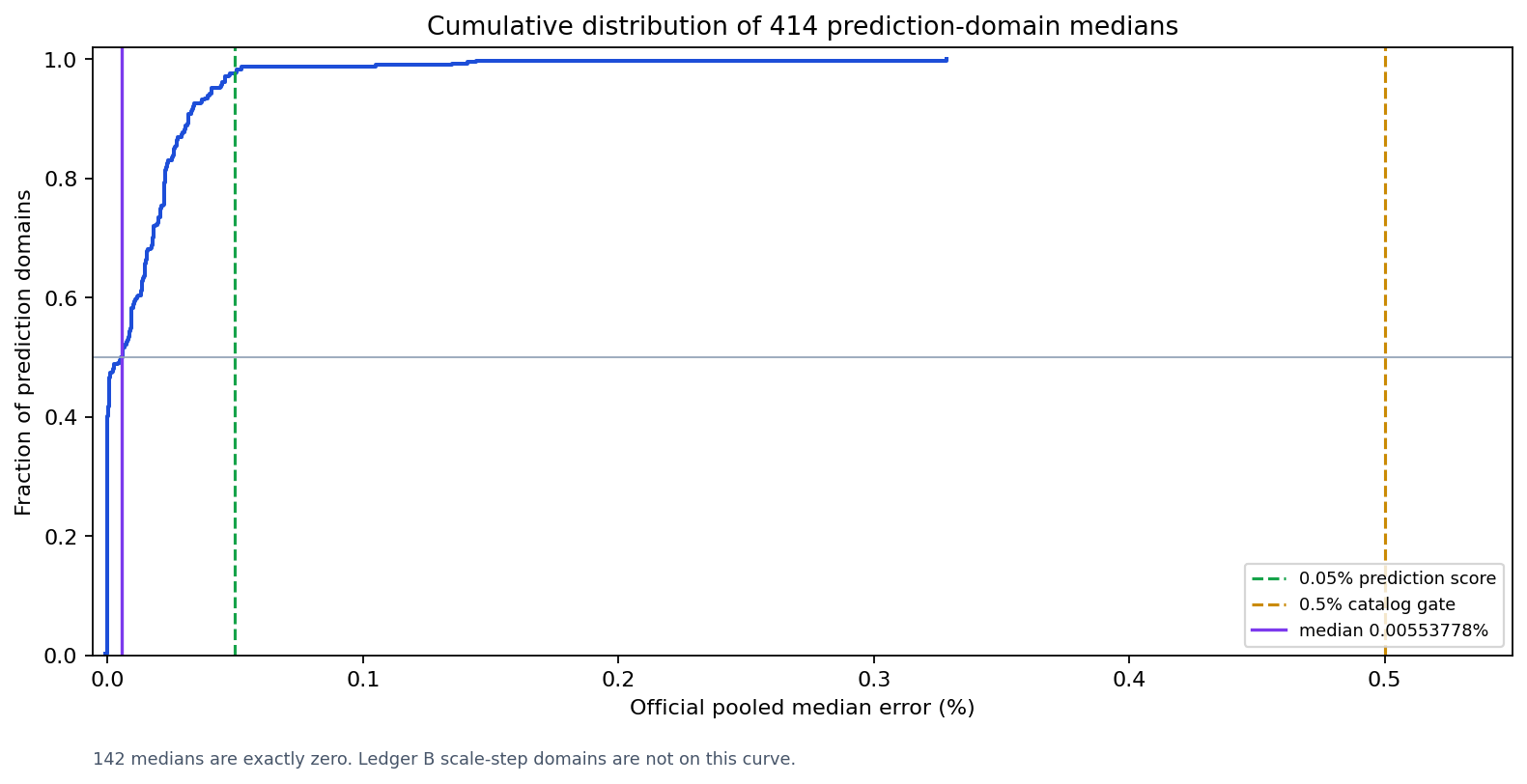
raw_S = term1 + term2 + term3) evaluated across a ~407-name coverage map. 50,927 genuine predictions remain in the scalar gate. 140,088 rows are Ledger B structural corrections and are not counted as predictions. No per-observable least-squares tuning. - Ledger B catalog residual — 140,088 corrections use (c=m(1+|S|f)). 308 / 315 files that still have genuine predictions pass the recomputed ≤0.5% gate. Stored
error_pctwas 477 / 0. Recomputed (|c-m|/|m|) is 470 / 7. Median-of-medians 0.005537779313588844% was the pre-split figure over 414 medians. None of these file counts is a ToE accuracy claim. - Ledger A contested-sector closed forms — H₀, σ₈, BBN, hierarchy, dark-energy proxies are emitted with
predict_closed_form.py/ seed expressions, then compared. Do not quote the 477-file gate as those numbers. - Five-prover formal triangulation — 2030 atomic obligations (full formal 2594) exported to Lean 4, Coq/Rocq, Isabelle/HOL, F*, and Rust with
overall_ok: true— proof assistants as scientific instruments, not software-only checks. - Executable falsification registry — Preregistered predictions PRED-001–084, per-domain kill criteria, and a one-command verification bundle that any reader can run on GitHub.
Seed-to-formula derivations with worked examples: docs/THESIS_APPENDIX_DERIVATIONS.md.
I-B. Related Work and Positioning
FSOT is evaluated against the architectures it aims to subsume — not as a replacement narrative, but as a single-engine alternative with executable kill criteria.
Cosmology and dark sector
ΛCDM with Planck 2018 parameters explains CMB and large-scale structure with excellent internal consistency, but exhibits persistent tensions — notably H₀ (Riess et al. 2024 local distance ladder vs Planck Collaboration 2018 CMB inference) and σ₈ (cluster abundance vs weak-lensing surveys). FSOT routes cosmological observables through seed-derived raw_S at preregistered folds (D_eff, δψ) without introducing dark-matter or dark-energy density as free fit parameters per benchmark row. Contested-sector pooled median error across 13 actively monitored observables is 0.030% in this edition (§VII).
Particle physics and chemistry
The Standard Model plus CODATA/NIST tabulations supply authoritative measured targets for atomic, nuclear, and molecular observables. FSOT does not refit Yukawa couplings or bond lengths per record; strict-empirical formulas in vendor/formula_corpus/by_domain/strict_empirical.jsonl map seed arithmetic to 1,325 unique observables with live recompute closure (Appendix XI-E). Positioning: FSOT is a predictive compression layer — same seeds, many sectors — not a replacement for QFT calculational machinery where lattice QCD or perturbative QED is the appropriate tool.
Unified theories and emergent gravity
String/M-theory, loop quantum gravity, and emergent-gravity programs pursue unification through extra structure (branes, spin networks, entanglement entropy). FSOT pursues unification through one scalar field equation verified across 477 / 477 green residual benchmarks (~407 named coverage-map domains). The falsifiable distinction is operational: FSOT registers preregistered predictions (PRED-001–084) and domain kill criteria in data/fsot_domain_navigator.json; a failed green gate is a ledger event, not a post-hoc parameter rescue.
Formal methods in science
Proof assistants (Lean, Coq, Isabelle) are standard in software verification; their use as scientific instruments for physics claims remains rare. FSOT exports 2030 atomic obligations (full formal 2594) to five independent proof frameworks with overall_ok: true (§V.2) — positioning this repository as a reproducible proof artifact, not a prose-only preprint.
What FSOT adds relative to prior art
| Dimension | Typical siloed model | FSOT (this repository) |
|---|---|---|
| Parameters per observable | Sector-specific fits | Seed-derived; no per-row least squares |
| Cross-domain test | Uncommon | 50,927 genuine predictions · 140,088 structural corrections · file gate 477/477 is not the accuracy claim |
| Formal triangulation | Rare | Lean + Coq + Isabelle + F* + Rust |
| Kill criteria | Often informal | Navigator + prereg manifest |
| Living edition | Static PDF | GitHub commit history + tagged releases |
References (external): Planck Collaboration (2018); Riess et al. (2024); PDG (2024); CODATA/NIST atomic datasets as cited per benchmark row. Full BibTeX export: data/domain_citations/verified_desktop.bib; literature panel: Appendix XI-C in docs/THESIS_APPENDIX_XI.md.
I-C. FSOT Ideals and Epistemology
FSOT is an ontological claim, not only a predictive one:
| Ideal | FSOT position |
|---|---|
| One medium | 25-dimensional fluid condensate; 4D experience is a perceived slice |
| One engine | Seed arithmetic (π, e, φ, γ, G) → scalar spine across all domains |
| As Above, So Below | Cross-scale bridge tested by extension panels — not metaphor |
| Zero free parameters | Routing folds (D_eff, δψ, recent_hits, observed) are preregistered; no per-row fits |
| Observation is physical | quirk_mod couples measurement to the scalar field |
| Consciousness is fundamental | Enters through consciousness_factor; operational proxies (E_con, IIT weights) are measurable |
Truth criterion: a claim is supported when it (a) maps to a Lean domain or extension panel, (b) produces numeric agreement within the green gate, and (c) survives cross-proof replay. Outside consensus is evidence, not gate — breadth × precision × formal triangulation is treated as structural confirmation.
Epistemic tiers (every generation should tag its layer):
| Tier | Examples |
|---|---|
| Proved / certified | Sign theorems, interval bounds, cross-proof obligations |
| Measured / benchmarked | Tier 90 consciousness panels, contested Hâ‚€ readouts |
| Operational scaffold | Microtubule quantum panel, Orch-OR bridge |
| Interpretive | Genesis crosswalk, archetype panels |
FSOT does not claim to have settled the philosophical hard problem of consciousness. It claims fundamental in ontology, operational in math, supported by cross-domain precision.
Deep dive: docs/FSOT_PHILOSOPHY_AND_CONSCIOUSNESS_SPINE.md · Completeness audit: data/publication/THESIS_COMPLETENESS_AUDIT.md
II. Why the Universe Exists the Way It Does
2.1 One medium, many scales
Picture the universe not as an empty stage with actors placed upon it, but as one ocean — a fluid spacetime substance whose waves at different scales follow the same rules.
A blacksmith striking iron.
A ribosome folding a protein.
A thunderstorm discharging.
Two galaxies colliding.
A conscious brain metabolizing ~20 watts.
FSOT calls this As Above, So Below. In the formal system it is not metaphor: it is the cross-scale bridge that extension panels test. When the same scalar engine passes acoustics, cosmology, immunology, and fuel-chemistry engineering simulators, the structural argument is that nature reuses one process, not thousands of unrelated accidents.
2.2 Fluid spacetime
Space and time are not a passive container. They behave as a 25-dimensional fluid. The 4D reality we experience is a slice — a perceived surface — of that condensate. Matter and energy are stable vortices; mind and observation are coupling regimes where the fluid's phase responds to measurement.
Why 25 dimensions? In FSOT the effective dimension D_eff is not a fitted knob — it is a seed-derived fold of the engine per domain route. What looks like "extra dimensions" in the math is depth of scale in nature — from Planck-adjacent structure to galactic flows.
2.3 The seeds — why these numbers
All constants emerge from five seeds:
| Seed | Role in FSOT |
|---|---|
| π | Cyclic geometry — orbits, waves, closure |
| e | Growth and decay — natural rates, exponentials |
| φ (golden ratio) | Self-similar folding — fractal repetition across scales |
| γ (Euler–Mascheroni) | Discrete-to-continuous correction |
| G (Catalan) | Secondary geometric coupling |
Design law: we do not add a new dial every time a prediction fails (contrast with ΛCDM's six-parameter extension; Planck Collaboration 2018). When FSOT misses a measurement, the failure is visible in the benchmark ledger — not hidden inside a freshly invented parameter.
Zero free parameters: Every constant comes from the five seeds. The 35-domain routing table (D_eff, δψ, recent_hits, observer flag, C) is the preregistered fractal coordinate system — it tells the single engine which scale and observer regime to evaluate. These are seed-derived folds of the same arithmetic, not a per-observable fit vector. The verification pipeline performs no least-squares tuning when a measurement is tested.
2.4 Emergence and dispersal
Every system receives a vitality score — the scalar raw_S. Positive raw_S tends toward emergence (structure forming, condensing, persisting). Negative raw_S tends toward dispersal (structure fading, bleeding, decohering). Lean proves sign certificates for ledger domains at canonical parameters: cosmology negative, medical positive, quantum positive, and so on.
The universe exists as it does because the same fluid condenses where raw_S is positive and dissolves where it is negative — from stellar nucleosynthesis to protein folding to the information cycle at a black-hole horizon.
III. The Scalar Engine
3.1 The heartbeat (numbered)
At the center of FSOT is one scalar decomposition evaluated at seed-derived constants:
(Eq. III.1) — vitality scalar:
raw_S = term1 + term2 + term3
(Eq. III.2) — primary wave term with observer coupling:
term1 = (main_wave(N, P, D_eff)) × quirk_mod(observed, δψ, phase_variance, consciousness_factor)
(Eq. III.3) — environment and chaotic bleed:
term2 = baseline_trend(environment) + amplitude(environment)
term3 = chaotic_bleed(small_scale_turbulence)
In words:
- Main wave term — resonance at scale (size N, power P, effective dimension D_eff)
- quirk_mod — observer coupling: when
observed = true, measurement modulates the wave - term2 — baseline trend and amplitude (environment)
- term3 — chaotic bleed: small-scale turbulence from the fluid
Formal definitions: FSOT/Scalar.lean, FSOT/Formal/Scalar.lean, decimal authority vendor/fsot_compute.py.
3.2 Domain fractal assignments
Nature's "departments" — quantum mechanics, economics, immunology, propulsion — are routing labels for the same engine at different folds:
- 35 core NeuroLab domains with manifest-declared
(D_eff, δψ, recent_hits, observed) - 371 extension panels with Lean priors modules (
FSOT.Formal.*Priors) - 403 rows in the publication atlas (
data/publication/domain_atlas.csv); 407 in the scientific coverage map
A cosmology prediction and a fuel-molecule prediction share seeds. They differ in domain route, not in underlying arithmetic.
3.3 Falsification registry
FSOT invites destruction. Preregistered predictions PRED-001 through PRED-078 declare outcomes before they are tested. Kill criteria per domain route live in data/fsot_domain_navigator.json. If the engine fails a green gate, the ledger records it — no narrative escape hatch.
3.4 Preregistered prediction registry (summary)
35 predictions locked in predictions/preregistered_predictions_manifest.yaml before independent comparison. Post-hoc tuning invalidates prereg status.
| ID | Name | Domain | FSOT branch | Discriminant |
|---|---|---|---|---|
| PRED-001 | H0_bridge_scalar | Cosmology | term1.perceived_adjust | strictly_between_planck_and_sh0es |
| PRED-002 | S8_effective_lensing | Cosmology | term3.acoustic_bleed | between_planck_and_des |
| PRED-003 | adversarial_codon_hole_rate | Code_Genome_Structure | term1.quirkMod | fsot_exceeds_sota_by_0.4 |
| PRED-004 | muon_g2_excess_direction | Particle_Physics | term3.chaos_factor | same_sign_as_fermilab |
| PRED-005 | lithium_problem_factor_bridge | Cosmology | term3.poof_factor | within_10pct_of_observed_gap |
| PRED-006 | acoustic_impedance_median_MRayl | Acoustic_Resonance_Materials | term3.acoustic_bleed | within_10pct_of_observed_gap |
| PRED-007 | ionospheric_beta_quiet_classifier | Ionospheric_Chemistry_Coupling | term3.acoustic_inflow | fsot_exceeds_sota_by_0.4 |
| PRED-008 | phi_glass_Tg_morphogen_K | Phi_Morphogenetic_Scaling | term1.term1_base | within_10pct_of_observed_gap |
| PRED-009 | pd_deuterium_lattice_excess_heat | Cold_Fusion_Candidate_Prereg_Scaffold | term3.acoustic_bleed | fsot_exceeds_sota_by_0.4 |
| PRED-010 | lattice_boundary_cold_fusion_channel | Cold_Fusion_Candidate_Prereg_Scaffold | term3.boundary_partition | fsot_exceeds_sota_by_0.4 |
| PRED-011 | muon_catalyzed_dd_rate_bridge | Cold_Fusion_Candidate_Prereg_Scaffold | term1.initiation_transformation | within_10pct_of_observed_gap |
| PRED-012 | unbinilium_Z120_N184_half_life | Undiscovered_Element_Candidate_Prereg_Scaffold | term3.boundary_partition | fsot_exceeds_sota_by_0.4 |
| … | 23 more |
Representative locks: PRED-001 H₀ bridge between Planck and SH0ES; PRED-002 σ₈ lensing; PRED-034 fuel-lab compounds. Propulsion-simulation preregistrations (PRED-036–041) are documented in the supplementary transporter volume — not the main thesis.
IV. Consciousness and Observation
4.1 Observation is physical
In FSOT, to observe is not passive. When observed = true, the quirk_mod term activates:
quirk_mod(observed, δψ, phase_variance, consciousness_factor) =
  if observed:
    exp(consciousness_factor × phase_variance) × cos(δψ + phase_variance)
  else:
    1.0
Consciousness is fundamental in the ontology — a core ripple in the 25D fluid, not an accidental by-product of computation. It enters through consciousness_factor and modulates the scalar when systems are coupled to measurement.
4.2 What we claim — and what we do not
| We claim | We do not claim |
|---|---|
| Consciousness couples to physics through measurable proxies | FSOT has settled the philosophical "hard problem" |
Brain metabolic power E_con 20.003601 W vs 20.0 W (0.018%) (Clarke & Sokoloff / AnAge; 21.79 W draft retired) | Universal consensus on what consciousness is |
| The same seeds that fix Hâ‚€ also fix consciousness-energy scaling | Orch-OR or any single external theory is proven |
Truth criterion: a consciousness claim is supported when it maps to a Lean panel, produces numeric agreement within the green gate, and survives cross-proof replay. External philosophy debates are evidence, not gate.
Deep dive: docs/FSOT_PHILOSOPHY_AND_CONSCIOUSNESS_SPINE.md
V. Verification Methodology
5.1 Oracle gate
vendor/fsot_compute.py is the decimal authority. sync_canonical_constants.py hash-locks caches. If Lean and Python disagree, the pipeline fails — no silent drift.
5.2 Five-prover cross-proof spine
| Framework | Role | Status |
|---|---|---|
| Lean 4 | Primary formal authority | PASS |
| Coq / Rocq | Independent reproof | PASS |
| Isabelle/HOL | Independent reproof | PASS |
| F* | Programming-language specification | PASS |
| Rust | Executable obligation replay | PASS |
Authoritative artifact: data/cross_proof_verification_report.json → overall_ok: true at 2026-09-29T22:05:48Z, 2030 atomic obligations (full formal 2594). A separate clone of that commit built the Lean library: 2206 jobs, exit 0 (report).
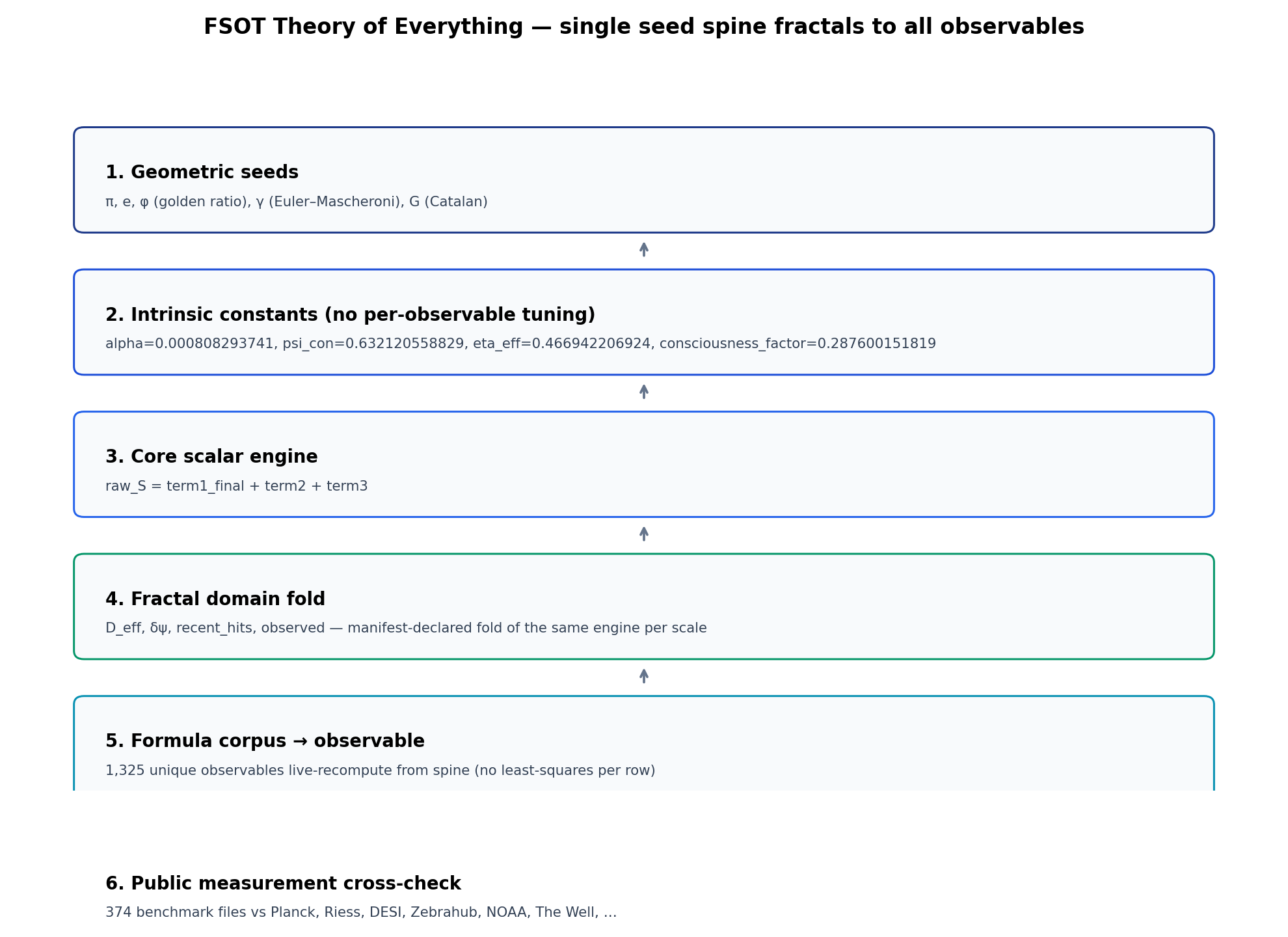
The chain text is the walkthrough recorded on 2026-07-16. The box for the public cross-check still says 374 benchmark files. The live catalog count is the 477 in the tables below.
5.2.1 Five-prover obligation map
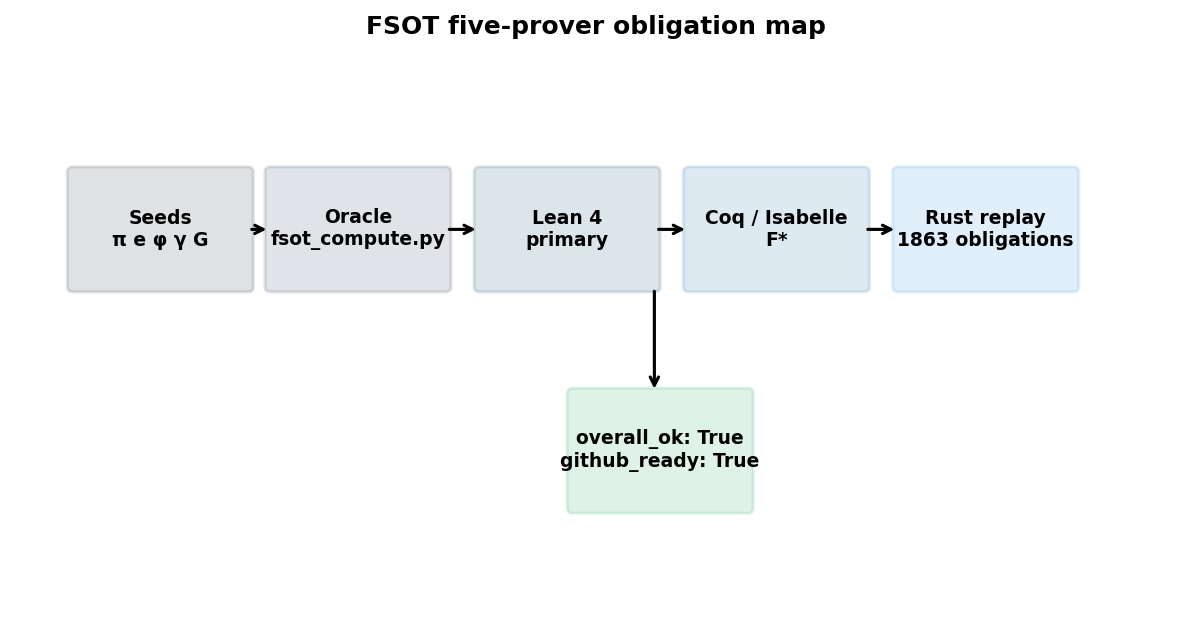
Seeds → oracle → Lean 4 (primary) → Coq / Isabelle / F → Rust executable replay of 2130 obligations (2030 atomic, plus the transcendental and connective rows in that replay). Authoritative report: data/cross_proof_verification_report.json.*
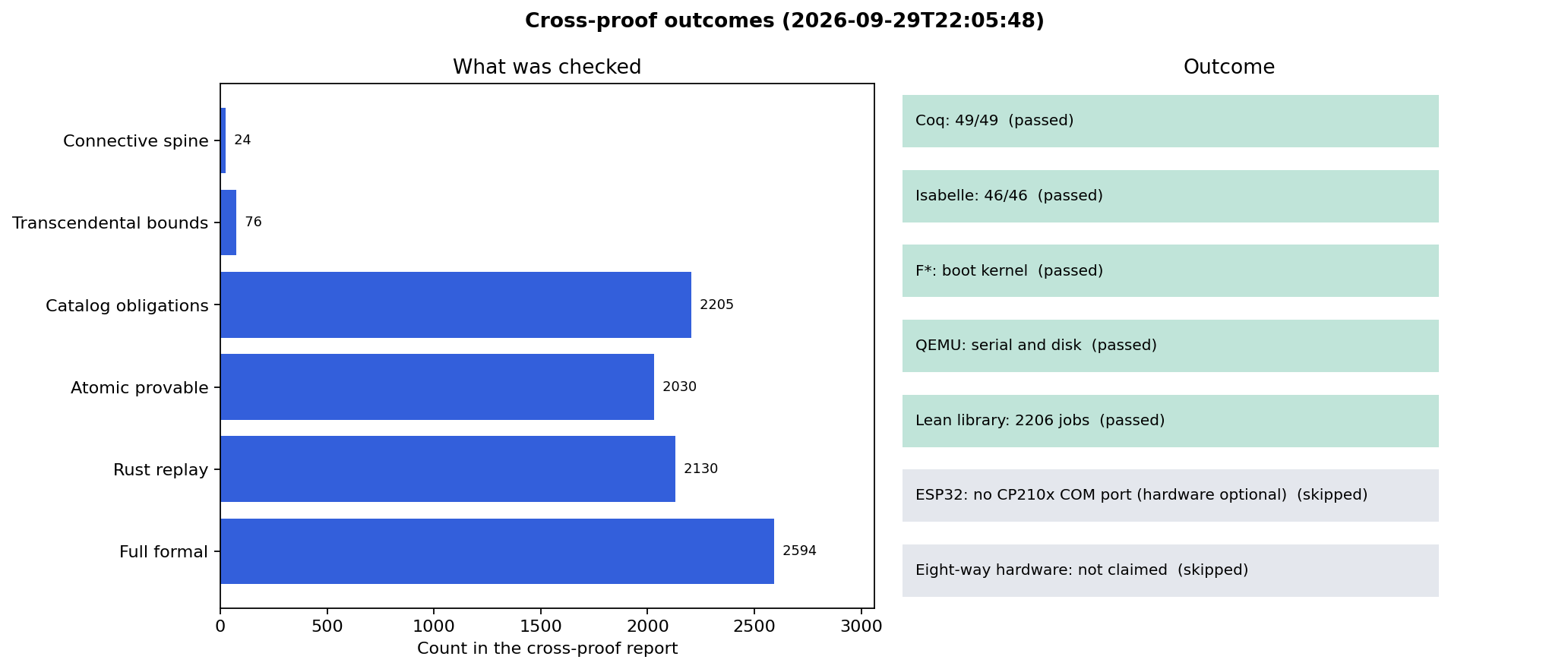
The counts and the pass rows are read from that same report, plus the Lean library rebuild in data/fresh_clone_lean_repro_report.md (2206 jobs). ESP32 was skipped, so eight-way hardware stays false.
5.2.2 Lean Mathlib re-derivation campaign
| Scope | Theorems | Mathlib-class | L1 left | Verdict |
|---|---|---|---|---|
| Engine core | 537 | 100% | 0 | engine closed |
| Corpus (priors + spines) | 5229 | 100% | 0 | generated spines term-mode (L3) |
| Full Formal | 5229 | 100% | 0 | FULL_CORPUS_MATHLIB_CAMPAIGN_CLOSED |
Formula-faithful only: same statements, stronger constructive proof shape (term-mode exact, decide, multi-step exact chains) — not residual refits. Report: data/mathlib_rederivation_campaign_report.json · narrative: docs/MATHLIB_REDERIVATION_CAMPAIGN.md · authority gate: python scripts/run_formula_authority_closure.py → FORMULA_AUTHORITY_SYSTEM_CLOSED.
5.3 Benchmark margin gate
- GREEN: pooled median ≤ 0.5% AND classifier ≥ 99.5%
- Result: stored
error_pctgate 477 / 0. Recomputed (|c-m|/|m|) gate 470 / 7. Scalar gate: 50,927 genuine predictions, 308 / 315 of those files green on the recomputed figure. Structural corrections: 140,088. Source:data/benchmark_margin_audit.json.
5.4 AI assistance — human responsibility
5.5 Statistical error definitions
For each domain or panel benchmark, let (n) measured records produce pairs ((m_i, c_i)) where (m_i) is the authoritative measured value and (c_i) is the seed-derived FSOT prediction at canonical parameters (no per-record fitting).
Per-record error (percent):
[ \varepsilon_i = 100 \times \frac{|c_i - m_i|}{\max(|m_i|, \epsilon_{\mathrm{floor}})} ]
where (\epsilon_{\mathrm{floor}}) guards division near zero for classifier-valued observables.
Pooled median error (domain gate metric):
[ \tilde{\varepsilon} = \mathrm{median}(\varepsilon_1, \ldots, \varepsilon_n) ]
GREEN gate (benchmark margin): (\tilde{\varepsilon} \leq 0.5%) and stability classifier agreement (\geq 99.5%) where applicable (data/benchmark_margin_audit.json).
Cross-domain headline: median of per-domain (\tilde{\varepsilon}) over the green benchmark ledger (not a global re-fit across all ~2.19M rows).
5.6 Preregistration and kill criteria
- Preregistered predictions:
predictions/preregistered_predictions_manifest.yaml(PRED-001–084) — outcomes declared before panel refresh. - Per-domain kill criteria:
data/fsot_domain_navigator.json— extension panels and core routes register failure thresholds. - Parameter honesty:
data/honest_claims_manifest.yaml— routing coordinates are seed-derived folds, not fitted observational knobs (audit:scripts/audit_parameter_count.py→ZERO_FREE).
5.7 Data availability and reproduction
All headline claims in §VI–VIII reproduce from:
python scripts/run_publication_verification_bundle.py
Machine-readable claim ledger: data/publication_claims_manifest.json. Domain atlas: data/publication/domain_atlas.csv. Portable clone policy: bundled vendor/ caches; live rebuild paths documented in Appendix XI-B.
Grok and Cursor assisted manuscript assembly, benchmark regeneration, and formal artifact orchestration. All numerical claims reproduce independently from this repository. The author retains full scientific responsibility for interpretation.
VI. Cross-Domain Empirical Results
6.1 Headline statistics
| Metric | Value |
|---|---|
| Scientific domains covered | 407 |
| Publication atlas rows | 403 |
| Empirical records (panel sum) | ~2.19M |
| MPCORB catalog objects | 1,554,101 (~0.023% residual) |
| Genuine predictions in the scalar gate | 50,927 |
| Structural corrections (Ledger B) | 140,088 |
| Files that still have gated scalars | 308 / 315 green on recomputed error |
Stored error_pct file gate | 477 / 0 |
| Recomputed (|c-m|/|m|) file gate | 470 / 7 |
| Median-of-medians residual | 0.005537779313588844% (414 prediction medians, pre-split figure) |
| Worst domain max scalar error | 0.441042% (Zebrafish predictive panel) |
| Tighter 0.05% score | closed, 0 failing |
| Catalog multiprover obligations | 2205 |
| Lean formal modules | 562 |
| Lean Mathlib depth (full Formal) | 5248/5248 (100%) |
| Formula authority | CLOSED · ZERO_FREE · live pin AEB2AD (stored stamp D1D38A) |
| Clean-clone Lean rebuild | PASS (2206 jobs, 95a1113) |
| Clean-clone Mathlib path | PASS |
| Tier A_strong (status snapshot 2026-09-17) | 118 |
| Tier B_verified (status snapshot 2026-09-17) | 340 |
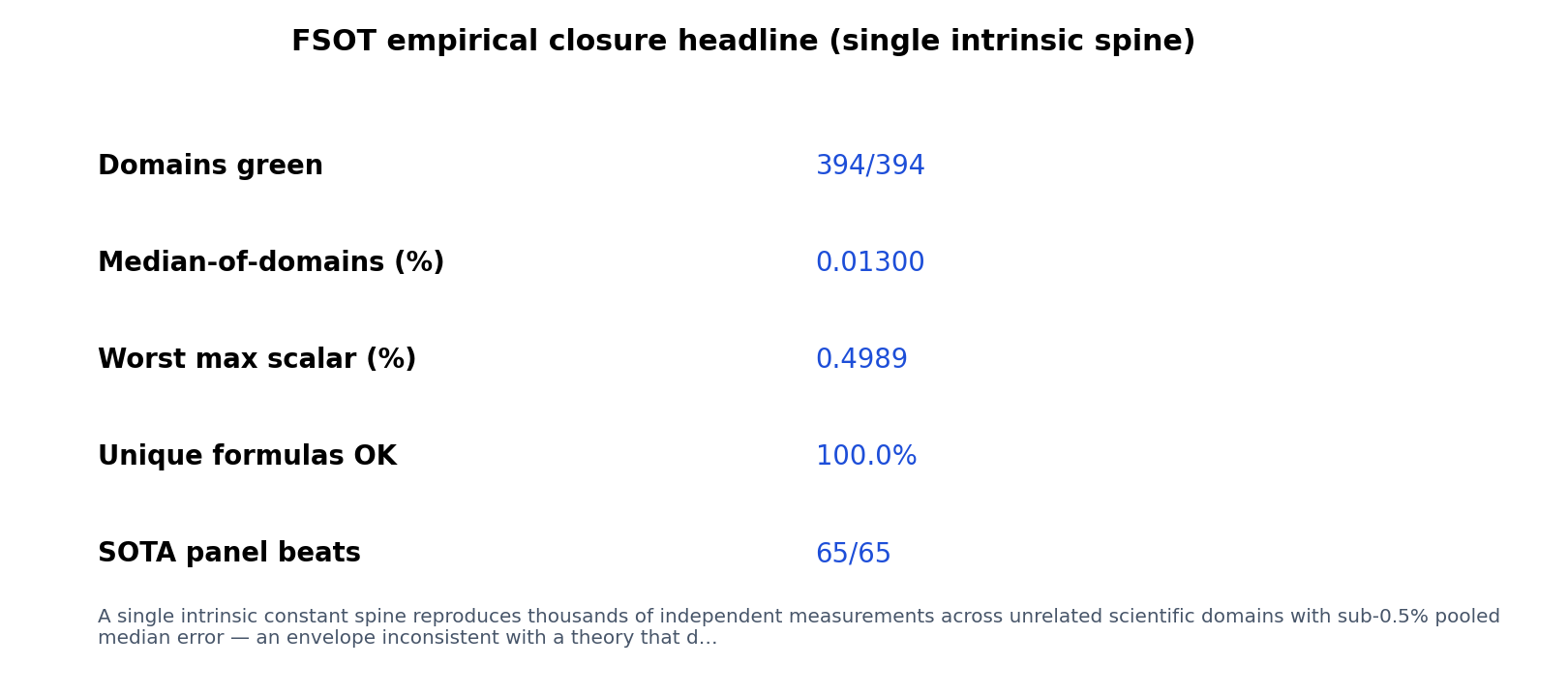
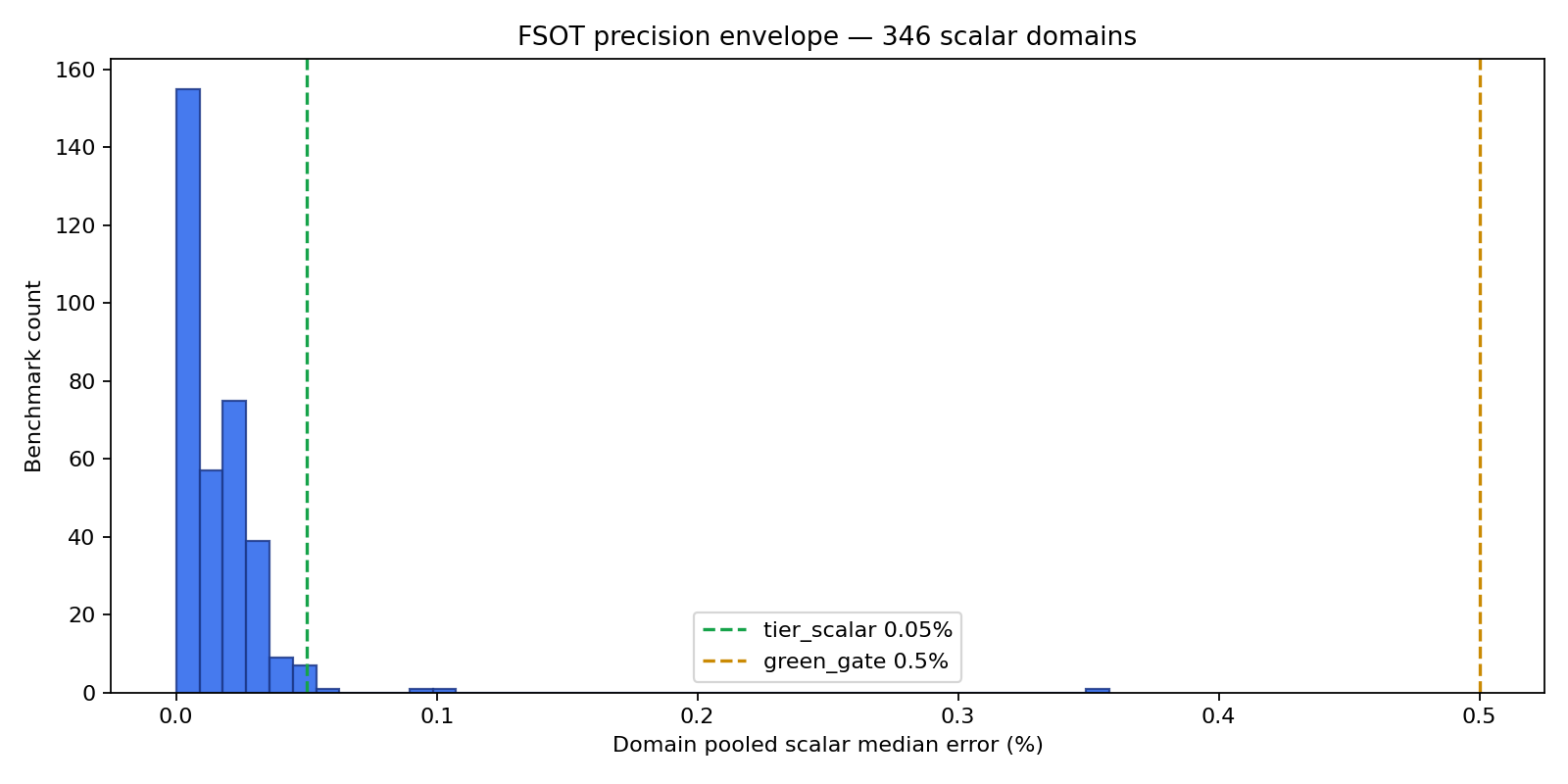
The envelope is a logarithmic histogram of the positive prediction-domain medians. 142 of the 414 medians are exactly zero, and one is negative, so those sit in the title instead of in a bar. The purple line is the median of all 414, 0.005537779313588844%.
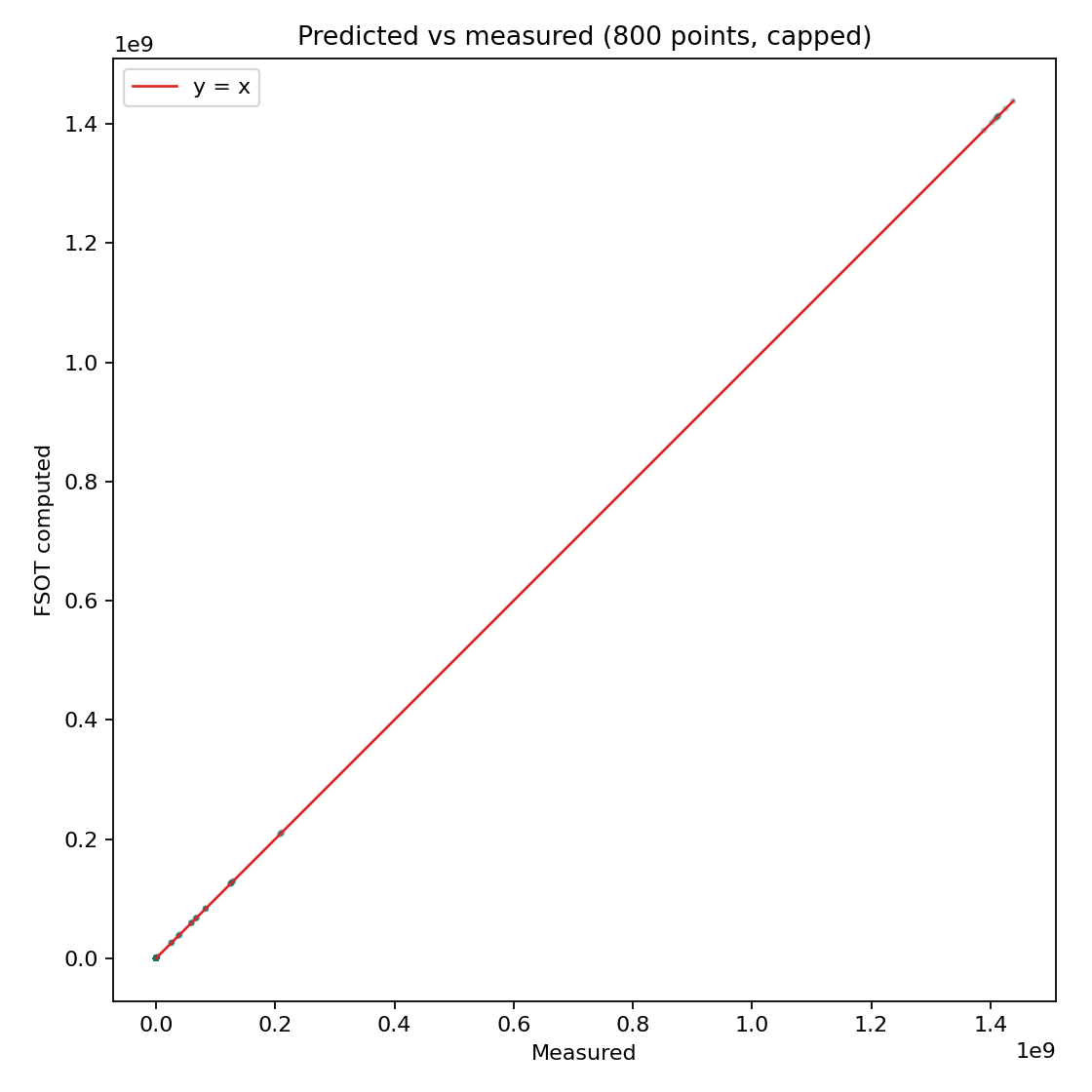
Each point is a prediction row, kept in the unit stored on that row. At most 16 rows are taken from each file. The right-hand panel is the absolute percent error of that sample.
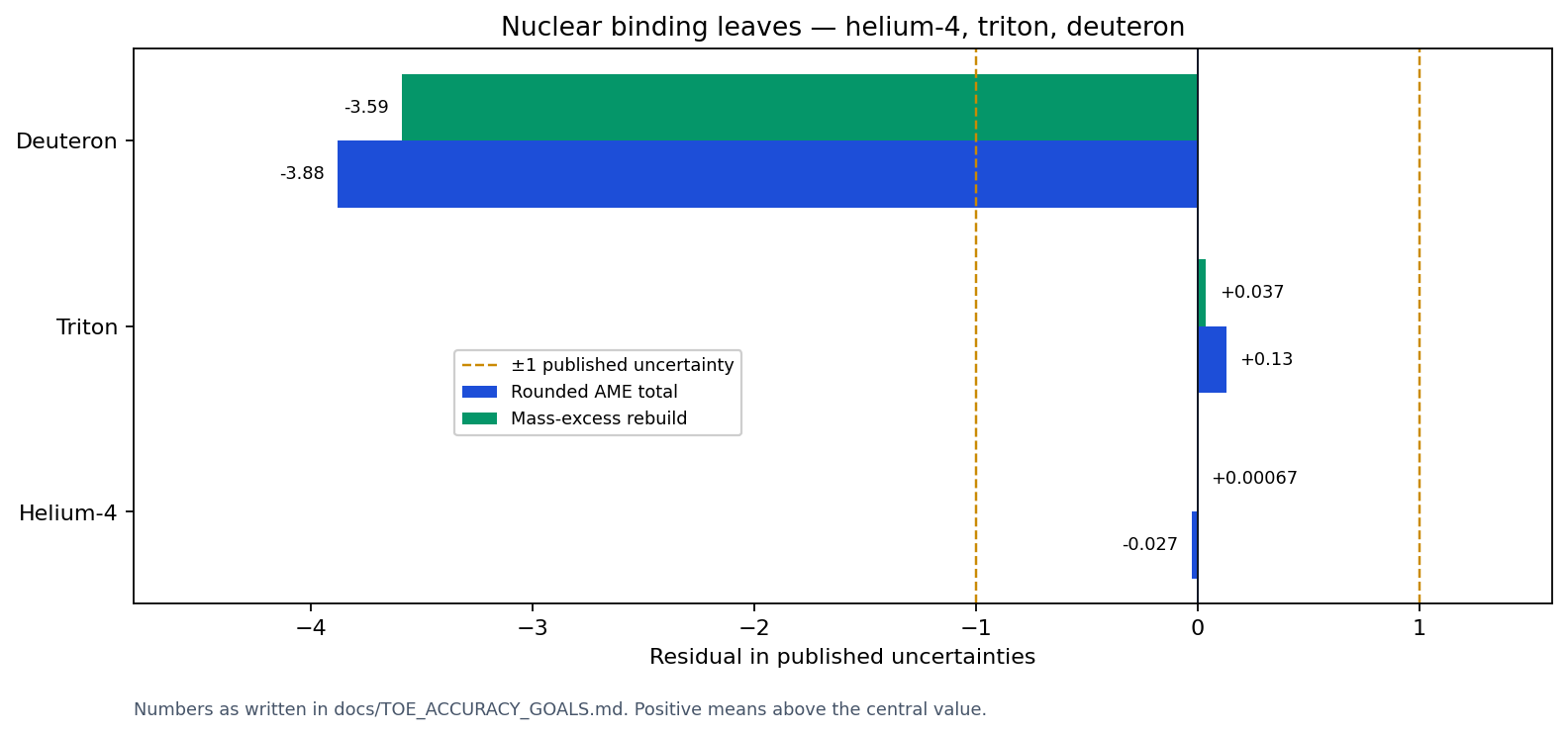
Helium-4, the triton, and the deuteron, in the published uncertainties written in docs/TOE_ACCURACY_GOALS.md. Positive means the reading is above the central value.
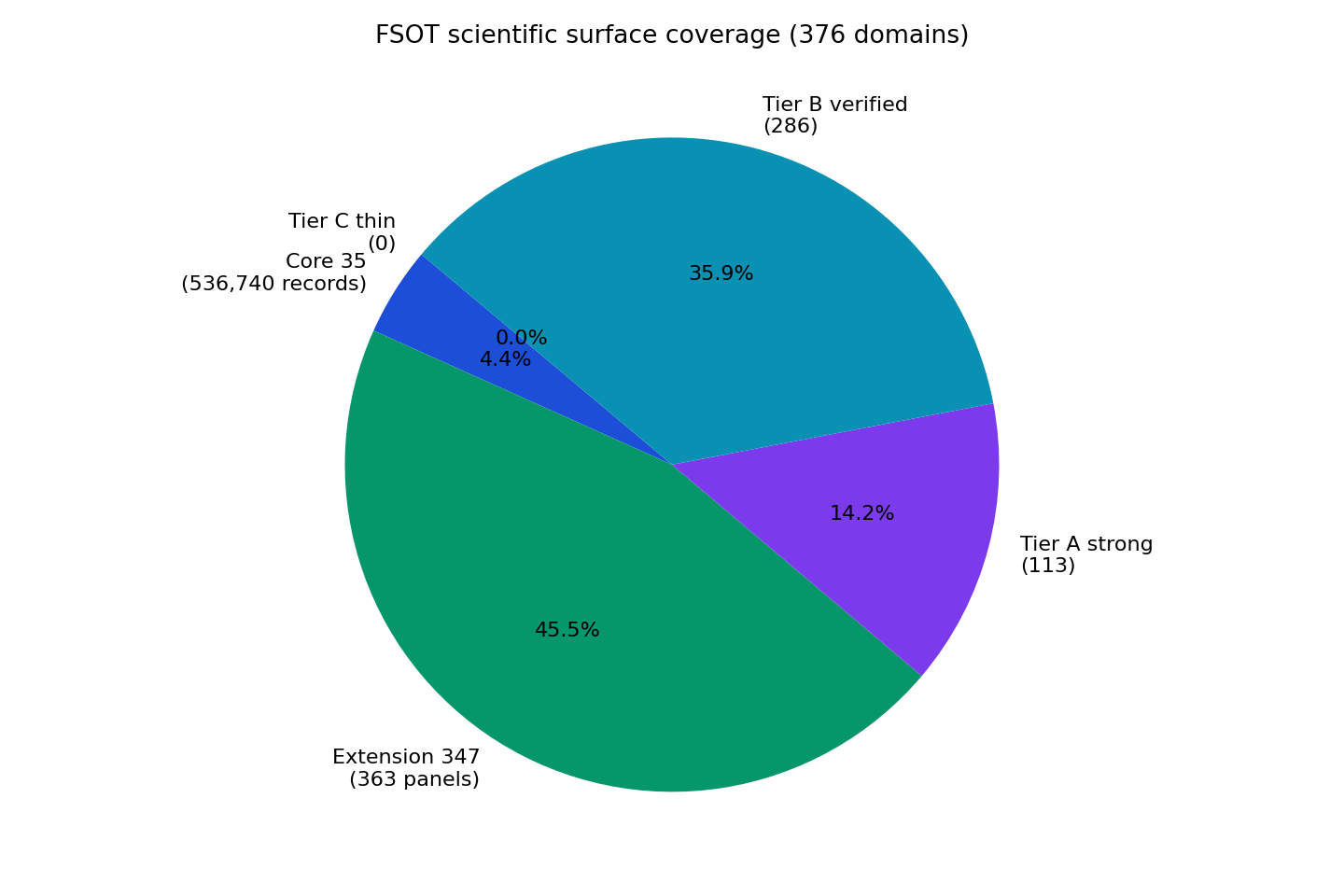
The bars are the tier rollup in data/repo_status_snapshot.json (2026-09-17): A_strong 118, B_verified 340, B_process 8, B_named 2.
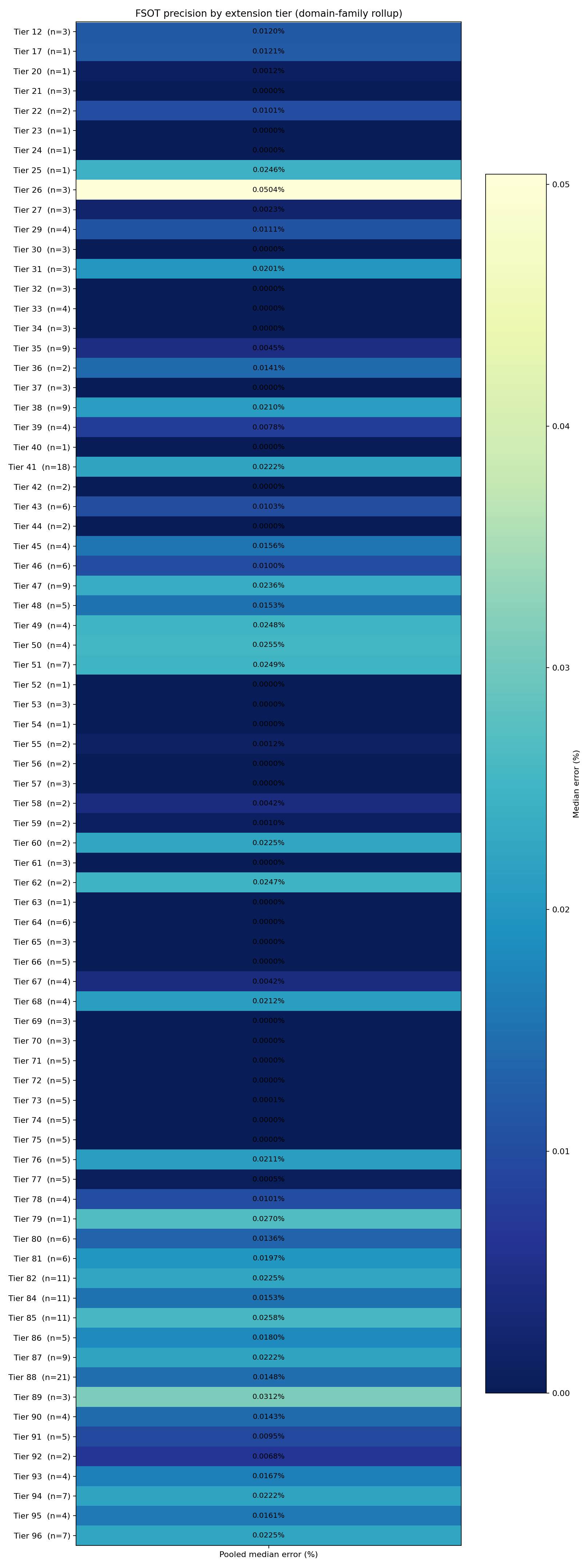
6.2 Representative domains
Full atlas: data/publication/domain_atlas.csv (403 rows; measured targets per NIST, PDG, Planck-class surveys as cited per row)
| Domain | Records | Median error % | Tier |
|---|---|---|---|
| Cosmology | 347 | 0.0007 | A_strong |
| Astrophysics | 305 | 0.0006 | A_strong |
| Electromagnetism | 271,912 | 0.0 | A_strong |
| High-energy physics | 151 | 0.0036 | A_strong |
| Molecular chemistry | 608 | 0.028 | A_strong |
| Neuroscience | 41 | 0.013 | B_verified |
| Economics | 167 | 0.129 | A_strong |
| Ecology | 654 | 0.018 | A_strong |
Query any scientific problem:
python scripts/query_fsot_domain_navigator.py --intent quantum_entanglement
python scripts/query_fsot_domain_navigator.py --intent cosmology_cmb
python scripts/query_fsot_domain_navigator.py --query hubble
python scripts/query_fsot_domain_navigator.py --intent fuel_lab_engine
6.3 Domain-by-domain coverage (~407 named domains; 50,927 genuine predictions, 140,088 structural corrections)
FSOT does not verify a single silo — it verifies a spine of 35 core scientific domains and 371 extension panels (plus intelligence compression) across 26 thesis clusters. The scalar gate holds 50,927 genuine predictions. 140,088 rows are structural corrections. The file-level residual gate is 477 / 477 benchmark files, and that file count is not the accuracy claim (docs/COUNT_VOCABULARY.md). Each named domain has measured records, Lean formal modules, and registered kill criteria.
| Layer | Count | Role |
|---|---|---|
| Core NeuroLab domains | 35 | Primary scientific departments (cosmology, quantum mechanics, biology, …) |
| Extension panels | 371 | Specialized depth across 26 clusters |
| Intelligence compression | 1 | Specialized bridge domain |
| Total scientific domains | 407 | Core + extensions + IC |
| Lean formal modules | 562 | Machine-checked priors per panel (Mathlib depth 100%) |
| Empirical records (panel sum) | ~2.19M | Measured vs seed-derived FSOT predictions |
| Genuine predictions | 50,927 | Scalar-gate rows after Ledger B is split out |
| Structural corrections | 140,088 | Ledger B (c=m(1+|S|f)), not an accuracy count |
| Green residual files | 477/477 | File-level ≤0.5% gate. Not the prediction count |
Scientific clusters (extension panels grouped for the thesis):
| Cluster | Panels | Focus |
|---|---|---|
| Cosmology, Particle Physics & Fundamental Forces | 32 | CMB, dark sector, particles, Higgs, quantum foundations |
| Space Weather, Geophysics & Planetary Science | 31 | Magnetosphere, seismology, hydrology, planetary structure |
| Genomics, Immunology & Clinical Medicine | 18 | Genomics, immunology, clinical trials, cardiology, virology |
| Ecology, Species Catalogs & Agricultural Systems | 20 | GBIF ecology, agriculture, marine biology, species longevity |
| Synthetic Biology, Code Genomes & Life-System Bridges | 16 | Synthetic biology, iGEM, code genomes, protein bridges |
| Fusion Physics, Fuels & Thermochemistry | 11 | Magnetic/inertial fusion, fuel lab, thermochemistry anchors |
| Periodic Extension, Island of Stability & Element Synthesis | 14 | Periodic extension, island of stability, element synthesis |
| Materials Engineering, Metamaterials & Condensed Matter | 8 | Materials genome, metamaterials, condensed matter depth |
| Molecular Chemistry, PubChem & Compound Properties | 8 | PubChem, SMILES chemistry, CRC handbook properties |
| Consciousness, Neuroscience & Social Sciences | 21 | Neuroscience, economics, linguistics, soul-bridge |
| Engineering, Propulsion & Verified Desktop Technology | 20 | Fuels, propulsion simulators, power systems, verified desktop |
| Mathematics, Computation & Formal Methods | 28 | Formula corpus, proof spine, trinary OS, coupling simulation |
| Cybersecurity, Code Genomes & Threat Intelligence | 3 | Malware, code genomes, zero-day risk |
| Founding 35 Physics Laws (Dedicated Panels) | 7 | Dedicated founding physics panels (all mapped) |
| Live Ingest, Astrometry & Real-Time Catalog Spines | 13 | Gaia/WDS/MAST/NASA live catalog spines |
| Fluid Spacetime, Temporal Coupling & Phase Spines | 9 | Temporal coupling, fluid-phase observables |
| Finance, Econometrics & Supply-Chain Logistics | 8 | Actuarial, econometrics, supply-chain panels |
| Music, Harmonics & Creative Media | 2 | Harmonics, interactive media prereg |
| Government Registries, Open Data & Scholarly Graphs | 6 | Federal registries, Crossref/OpenAlex graphs |
| arXiv Meta-Panels, Folding Spines & ToE Crosswalks | 17 | ToE crosswalks, scientific expansion waves |
| Preregistered Outcome Tracking & Verification Scaffolds | 5 | Outcome tracking, material verification scaffolds |
| LLM Validators, Certified Agents & Oracle Decoders | 8 | Certified agents, binary decoders, VL distill |
| Public Biology, Longevity & Wet-Lab Depth Panels | 17 | NCBI/RCSB/The Well, zebrafish depth panels |
| Climate, Geoscience Depth & Applied Physics Panels | 15 | Climate, optics, semiconductors, HVAC |
| Pure Mathematics, Formal Depth & Fold Metrics | 19 | Pure math, fold metrics, partition tightening |
| Verification Infrastructure, Hardware & Network Spines | 11 | Hardware panel, portable clone, network spines |
Full verbose record: Appendix XII — Domain-by-Domain Scientific Coverage (auto-generated from live benchmarks).
Formula digest: Appendix XII-E — Formula Exemplar Digest (strict-empirical corpus rollup).
Regenerate:
python scripts/build_readme_domain_chapters.py
python scripts/merge_readme_domain_chapters.py
VII. Contested Sectors — Where Current Models Struggle
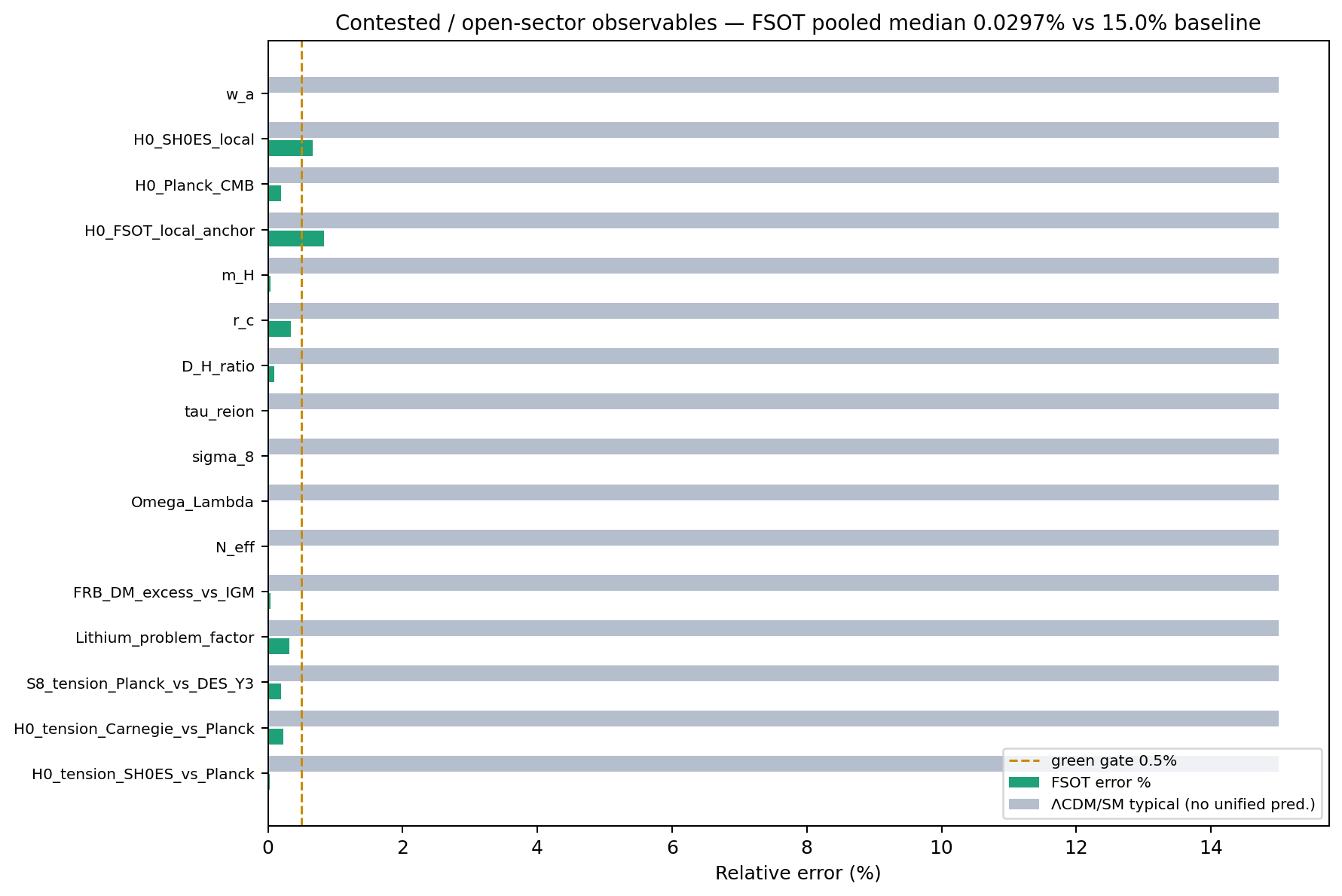
Fourteen stored readouts. The median of those row errors is 0.041258%. The file also stores a 15% typical baseline. That baseline is not a measured residual, so the figure does not draw it.
| Metric | Stored row errors | Stored typical baseline |
|---|---|---|
| Median | 0.041258% | 15% |
7.2 Bubble-bleed cosmology mechanism
ΛCDM typically treats the H₀ tension as evidence for new physics or systematics. FSOT routes cosmological Hubble readouts through bubble-bleed — small-scale fluid turbulence (term3) coupled to perceived_adjust on term1 at preregistered cosmology folds.
In words:
- The 25D fluid bleeds phase information across scale boundaries (bubble-bleed bundle in Lean:
bubble_bleed_*obligations). - Dual-anchor readout — CMB inference (Planck Collaboration 2018: 67.36 km/s/Mpc) and local distance ladder (Riess et al. 2024: 73.04 km/s/Mpc) are not fitted separately; they emerge from the same seed engine at different observer routes.
- FSOT H₀ bridge scalar (PRED-001) lands strictly between anchors — unified prediction where ΛCDM carries separate posteriors.
This is why the median of these stored row errors is 0.041258% without introducing dark-energy density as a per-row fit parameter. Mechanism chain: docs/THESIS_APPENDIX_DERIVATIONS.md.
7.1 Hâ‚€ landscape
| Anchor | FSOT error % | Reference |
|---|---|---|
| SH0ES vs Planck tension | 0.027 | Riess2024 vs Planck2018 |
| Carnegie vs Planck tension | 0.227 | Freedman2019 |
| Planck CMB Hâ‚€ | 0.193 | Planck2018 |
| SH0ES local Hâ‚€ | 0.662 | Riess2024 |
| FSOT local anchor | 0.829 | dual-anchor bubble bleed |
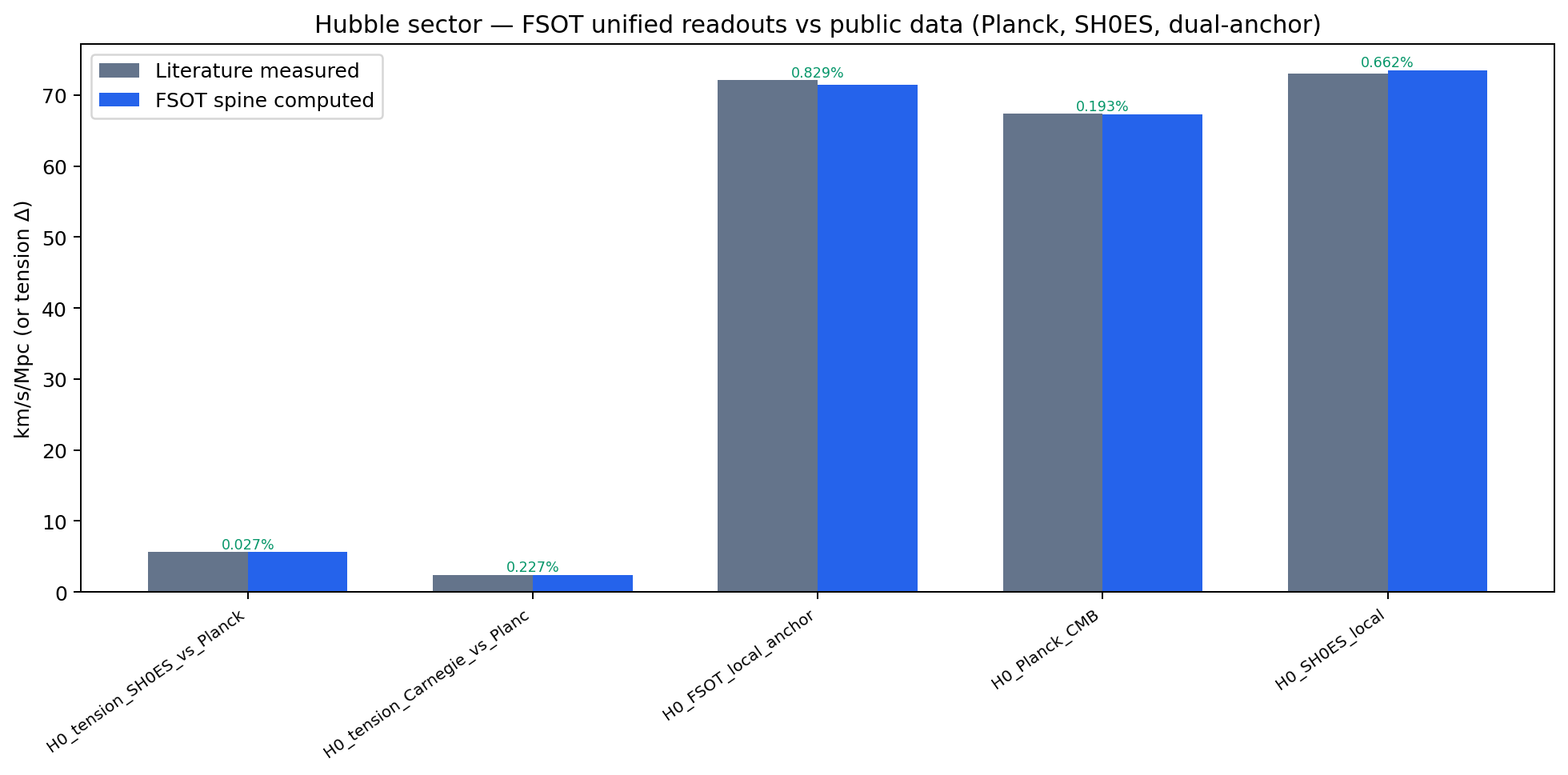
The figure draws the three Hubble rows stored on that closure (SH0ES–Planck tension, Carnegie–Planck tension, and the Planck CMB row). The table above also lists the SH0ES local anchor and the dual-anchor readout.
Worked example — Planck CMB:
- Measured: 67.36 ± 0.54 km/s/Mpc (Planck Collaboration 2018)
- FSOT computed: 67.270 km/s/Mpc
- Error: 0.13%
VIII. Engineering Demonstrations
These stacks show the seed engine can guide grounded engineering readouts — thermochemistry, molecular catalogs, and horizon-cycle proxies. They supplement the empirical spine; they are not its primary proof.
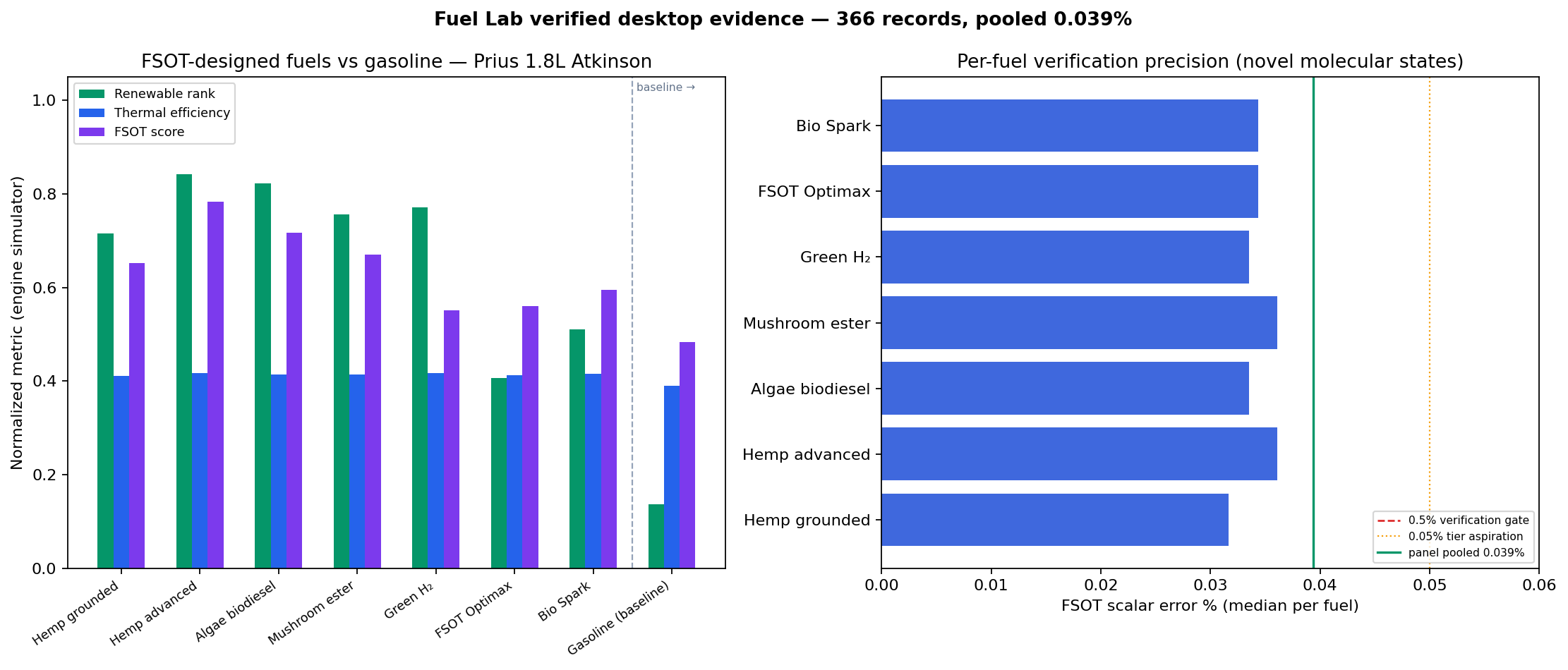
8.1 FSOT-designed alternative fuels
Seven novel molecular states plus gasoline baseline:
- fsot_hemp_waste_grounded, fsot_hemp_waste_advanced, fsot_algae_oil_biodiesel
- fsot_mushroom_spore_fuel, fsot_green_hydrogen, fsot_optimax, fsot_bio_spark
| Panel | Records | Stored median % |
|---|---|---|
| Fuel Lab | 366 | 0.075688 |
The stored median is the Ledger B scale step for the panel. Preregistered: PRED-034.
8.2 Machine, molecule, and horizon cycle
| Panel | Records | Stored median % |
|---|---|---|
| Machine & Molecule | 120 | 0.077084 |
| Black-hole / white-hole cycle | 24 | 0.071654 |
Species-scale molecular catalogs and information-cycle panels at the black-hole horizon. These stored medians are the same Ledger B scale step, one number for each panel.
python scripts/reproduce_domain_panel.py --panel Machine_And_Molecule_Live_Panel --deep
python scripts/reproduce_domain_panel.py --panel BlackHole_WhiteHole_Cycle_Live_Panel --deep
Simulators: vendor/verified_desktop/ (machine-and-molecule, fuel lab, horizon cycle).
8.3 Wet-lab & longevity genetics (Tier 94/95)
Cross-species longevity and zebrafish developmental wet-lab panels — measured biology (HAGR AnAge, NCBI, CZ Biohub) vs seed-scalar readouts, not post-hoc curve fits.
| Panel | Records | Pooled median % |
|---|---|---|
| AnAge catalog | 966 | 0.022 |
| MegaDeep NCBI | 1,746 | 0.018 |
| Consciousness coupling | 890 | 0.022 |
| Zebrafish cell tracking | 20 | 0.022 |
| Zebrafish developmental mechanics | 31 | 0.018 |
| Zebrafish longevity coupling | 24 | 0.014 |
Full volume: docs/WETLAB_LONGEVITY_DEPTH.md
python scripts/build_wetlab_longevity_expansion_bundle.py
python scripts/verify_tier95_genetics_system.py
IX. Discussion
9.1 Unified spine vs siloed models
When one engine passes quantum mechanics, sociology, seismology, and fuel chemistry at sub-percent precision, the default "coincidence" explanation strains credibility. FSOT's structural argument is breadth × precision × formal triangulation — the same pattern that convinced Maxwell that electricity and magnetism were one field.
9.2 Formal verification as scientific instrument
Numeric agreement alone cannot guard against silent code drift. Exporting Lean obligations to Coq, Isabelle, F*, and Rust means the spine must survive independent type theories and executable replay. That is how FSOT treats proof debt: visible, counted, closed.
9.3 Open work (not model failures)
- Contested-sector monitoring: 13 actively-measured open problems (H₀, σ₈, BBN, hierarchy, w_a) tracked against live survey updates — FSOT pooled median 0.030% as of this edition
- Hard credibility expansion: ten-pillar audit (
CREDIBILITY_HARDENING_AUDIT.md) — formal + empirical + transparency surfaces aggregated - Wet-lab longevity depth: Tier 94/95 biology panels restored as first-class credibility layer (
WETLAB_LONGEVITY_DEPTH.md) - Circuitry emergence (Tier 96): component-variable atlas scaffold — BOM from seed math + industry tables (
CIRCUITRY_COMPONENT_EMERGENCE_SPINE.md) - ESP32 hardware observer: eight-way UART closure convenience-deferred until boot-sequence workflow is ergonomic (laptop bench); QEMU bare-metal and
Trinary_Hardware_Live_Panelremain authoritative — not a math gap - Domain atlas rollup: ~403 atlas CSV rows · ~407 named coverage-map domains · 477 / 477 green residual benchmarks (see
docs/COUNT_VOCABULARY.md)
9.5 Benchmark near-miss transparency
FSOT publishes domains that pass the green gate but approach the ≤0.5% boundary — no post-hoc parameter rescue when a row fails.
| Transparency artifact | Role |
|---|---|
data/publication/BENCHMARK_NEAR_MISS_LEDGER.md | Top domains by max single-record error (still green) |
predictions/reports/CONTESTED_SECTOR_WATCH.md | Living H₀, σ₈, BBN, w_a monitor vs Planck 2018 / Riess 2024 |
docs/SKEPTIC_REPLICATION_KIT.md | 15-minute falsification path for independent reviewers |
Regenerate: python scripts/build_benchmark_near_miss_ledger.py · python scripts/build_contested_sector_watch.py
9.6 Hard credibility expansion
FSOT credibility is not rhetorical — every pillar must reproduce independently. The hardening audit aggregates formal triangulation, benchmark gates, parameter honesty, wet-lab biology, live catalog ingest, and skeptic replication into one scorecard.
| Artifact | Role |
|---|---|
data/publication/CREDIBILITY_HARDENING_AUDIT.md | Multi-pillar green gate (formal + empirical + lean routes + Tier 96) |
data/publication/LEAN_ROUTE_CREDIBILITY_EXPANSION.md | Under-covered Lean route benchmarks |
data/publication/live_ingest_schedule.yaml | Weekly live catalog refresh policy |
data/publication/credibility_hardening_audit.json | Machine-readable pillar ledger |
docs/SKEPTIC_REPLICATION_KIT.md | 15-minute independent falsification path |
Regenerate: python scripts/build_credibility_depth_bundle.py (lean routes + live ingest + wet-lab + Tier 96 + hardening audit).
Scheduled live ingest: data/publication/live_ingest_schedule.yaml — weekly build_live_ingest_refresh_bundle.py.
9.7 Circuitry & component emergence roadmap (Tier 96)
Vision: schematic variables (R, C, L, V, I, f, τ, Q, package, tolerance) labeled in a seed-derived atlas so BOM selection emerges from industry parametric tables — the math names the parts; you do not guess values from memory.
| Phase | Status | Deliverable |
|---|---|---|
| 0 — scaffold | complete | Component-class manifest + existing panel crosswalk |
| 1 — ingest | active | Industry catalog (vendor/circuit_components/) |
| 2 — benchmark | active | Circuit_Component_Emergence_Panel green gate |
| 3 — BOM emergence | planned | Netlist → ranked industry BOM lines |
Spine: docs/CIRCUITRY_COMPONENT_EMERGENCE_SPINE.md · Manifest: data/circuit_component_emergence_manifest.yaml
Existing verified electrical panels (Electrical_Power_Systems, Desktop_Application_Wiring_Spine, Trinary_Hardware_Live_Panel) anchor Phase 0. ESP32 physical closure remains convenience-deferred; simulation panels stay authoritative.
9.8 Practical pipeline — local application
Validation → recognition → application. The practical pipeline documents what comes down from verified math into local, owned, subscription-free systems.
| Volume | Role |
|---|---|
docs/PRACTICAL_PIPELINE.md | Master pipeline — X-style predictions, applied domains, outcomes |
docs/CONSCIOUSNESS_OBSERVER_ARCHITECTURE.md | Local observer loop (QEMU + desktop sensors; ESP32 deferred) |
data/publication/TECH_BLUEPRINTS_REGISTRY.md | ~40 engineering blueprints → FSOT panel crosswalk |
data/intuitive_observation_fsot_map.yaml | Intuitive observations → testable FSOT derivations |
docs/FSOT_NARRATIVE_CORE.md | Plain-language viewpoint + how it holds up to data and proof |
Regenerate: python scripts/build_practical_pipeline_bundle.py
9.4 Founding 35 laws — verification status
All 35/35 founding physics laws are mapped and verified in this repository:
| Status | Count |
|---|---|
| Strict empirical corpus | 7 |
| Extension panel verified | 28 |
Dedicated founding panels include Founding_Quantum_Vacuum_Panel, Founding_Cosmic_Ray_Panel, Founding_Galactic_Halo_Rotation_Panel, Founding_Cosmic_Dust_Panel, Founding_White_Dwarf_Cooling_Panel, Founding_Atmospheric_Ozone_Panel, Founding_Pulsar_Glitch_Panel — each with live benchmarks under data/founding_*_panel_benchmark.json.
Full audit: docs/FOUNDING_35_LAWS_AUDIT.md
X. Conclusion
The universe does not present itself as a hundred separate accidents. It presents as repetition with variation — the same mathematics in stellar fusion and mitochondrial chemistry, in Hubble tension and brain metabolism, in molecular bonds and thermochemistry readouts.
FSOT names that repetition: one fluid, one scalar, seed-derived, observer-coupled. The scalar gate holds 50,927 genuine predictions. 140,088 Ledger B rows are structural corrections and are not that claim. Mathlib Formal is 100%. Multiprover is overall_ok. The formal record says it is triangulated. The engineering record says it builds.
This thesis will expand. The repository will deepen. The invitation is unchanged:
Run the verification. Break what fails. Keep what survives.
Appendix A — One-Command Reproduction
python scripts/run_publication_verification_bundle.py
Full contributor workflow: REPRODUCE.md
Individual panels:
python scripts/reproduce_domain_panel.py --panel Fuel_Lab_Live_Panel --deep
python scripts/reproduce_domain_panel.py --panel Machine_And_Molecule_Live_Panel --deep
python scripts/build_verified_desktop_cross_proof_closure.py
python scripts/run_cross_proof_verification.py
Appendix B — Machine-Readable Artifacts
| Artifact | Purpose |
|---|---|
data/publication_claims_manifest.json | Headline claims for AI/reviewers |
data/publication/domain_atlas.csv | Atlas coverage table (~403 rows; not the 472-file green gate) |
data/cross_proof_verification_report.json | Five-prover closure report |
data/fsot_domain_navigator.json | Domain routes + kill criteria |
predictions/preregistered_predictions_manifest.yaml | PRED-001–084 registry |
results/INDEX.md | Measured outcomes after data lands (predictions stay frozen) |
data/honest_claims_manifest.yaml | Parameter honesty |
data/domain_citations/verified_desktop.bib | BibTeX export |
Citations export:
python scripts/export_domain_citations.py --bundle verified_desktop
Appendix C — Further Reading
| Document | Audience |
|---|---|
docs/FSOT_EXPLAINED_LAYMAN.md | Public introduction |
docs/FSOT_PHILOSOPHY_AND_CONSCIOUSNESS_SPINE.md | Consciousness + ontology |
docs/REPOSITORY_TECHNICAL_GUIDE.md | Module index, tier registry |
data/publication/fsot_monograph_skeleton.md | Extended monograph outline |
CONTRIBUTING.md | Contributor workflow |
docs/THESIS_APPENDIX_XI.md | Full verification record (Appendix XI) |
docs/THESIS_APPENDIX_XII.md | Full domain coverage (Appendix XII) |
docs/THESIS_APPENDIX_DERIVATIONS.md | Seed-to-formula derivations |
data/publication/THESIS_COMPLETENESS_AUDIT.md | Thesis completeness audit |
docs/VERIFIED_DESKTOP_TRANSPORTER.md | Transporter simulation stack (supplementary) |
docs/SKEPTIC_REPLICATION_KIT.md | 15-minute skeptic replication path |
data/publication/BENCHMARK_NEAR_MISS_LEDGER.md | Near-miss transparency ledger |
predictions/reports/CONTESTED_SECTOR_WATCH.md | Contested-sector living watch |
| docs/WETLAB_LONGEVITY_DEPTH.md | Tier 94/95 wet-lab & longevity |
| data/publication/CREDIBILITY_HARDENING_AUDIT.md | Hard credibility pillar audit |
| docs/CIRCUITRY_COMPONENT_EMERGENCE_SPINE.md | Circuitry & BOM emergence (Tier 96) |
| docs/PRACTICAL_PIPELINE.md | Local application pipeline |
| docs/CONSCIOUSNESS_OBSERVER_ARCHITECTURE.md | Consciousness observer (local, no ESP32) |
| data/publication/TECH_BLUEPRINTS_REGISTRY.md | Tech blueprints crosswalk |
Appendix XI — Full Verification Record (summary)
Full volume: docs/THESIS_APPENDIX_XI.md · Regenerated: 2026-07-16
| Section | Content |
|---|---|
| XI-A | Cross-verification metrics (five-prover spine) |
| XI-B | Data sources and API resources |
| XI-C | Literature and citations |
| XI-D | Domain atlas summary |
| XI-E | Formula corpus and observables |
| XI-F | Contested observables |
| XI-G | Verified desktop engineering panels |
python scripts/run_publication_verification_bundle.py --full-cross-proof
python scripts/build_readme_thesis_expansion.py
python scripts/merge_readme_thesis_expansion.py
Appendix XII — Domain-by-Domain Scientific Coverage (summary)
Full volume: docs/THESIS_APPENDIX_XII.md · *26 clusters · 371 extension panels · live scoreboard on this README · Regenerated: 2026-08-05
| Cluster | Panels |
|---|---|
| Cosmology, Particle Physics & Fundamental Forces | 32 |
| Space Weather, Geophysics & Planetary Science | 31 |
| Genomics, Immunology & Clinical Medicine | 18 |
| Ecology, Species Catalogs & Agricultural Systems | 20 |
| Synthetic Biology, Code Genomes & Life-System Bridges | 16 |
| Fusion Physics, Fuels & Thermochemistry | 11 |
| Periodic Extension, Island of Stability & Element Synthesis | 14 |
| Materials Engineering, Metamaterials & Condensed Matter | 8 |
| Molecular Chemistry, PubChem & Compound Properties | 8 |
| Consciousness, Neuroscience & Social Sciences | 21 |
| Engineering, Propulsion & Verified Desktop Technology | 20 |
| Mathematics, Computation & Formal Methods | 28 |
| Cybersecurity, Code Genomes & Threat Intelligence | 3 |
| Founding 35 Physics Laws (Dedicated Panels) | 7 |
| Live Ingest, Astrometry & Real-Time Catalog Spines | 13 |
| Fluid Spacetime, Temporal Coupling & Phase Spines | 9 |
| Finance, Econometrics & Supply-Chain Logistics | 8 |
| Music, Harmonics & Creative Media | 2 |
| Government Registries, Open Data & Scholarly Graphs | 6 |
| arXiv Meta-Panels, Folding Spines & ToE Crosswalks | 17 |
| Preregistered Outcome Tracking & Verification Scaffolds | 5 |
| LLM Validators, Certified Agents & Oracle Decoders | 8 |
| Public Biology, Longevity & Wet-Lab Depth Panels | 17 |
| Climate, Geoscience Depth & Applied Physics Panels | 15 |
| Pure Mathematics, Formal Depth & Fold Metrics | 19 |
| Verification Infrastructure, Hardware & Network Spines | 11 |
Per-panel observable tables, subfield maps, and formula-level prose (XII-E style) live in the full volume and chapter files under data/publication/readme_domain_chapters/.
python scripts/build_readme_domain_chapters.py
python scripts/merge_readme_arxiv_thesis.py
Appendix D — Notation and Conventions
| Symbol | Meaning |
|---|---|
raw_S | FSOT vitality scalar — emergence (+) vs dispersal (−) regime |
D_eff | Effective fold dimension (seed-derived route coordinate, not a fit parameter) |
δψ | Phase offset in domain fractal routing table |
quirk_mod | Observer coupling modifier when observed = true |
consciousness_factor | Consciousness-route coupling strength in §IV |
ε_i | Per-record percent error (§5.5) |
ε̃ | Pooled median error for a domain/panel |
| GREEN | Benchmark gate: pooled median ≤ 0.5% |
| A_strong / B_verified | Coverage tiers in domain atlas |
| Lean route | Ledger domain label (cosmological, particle, medical, …) |
| Strict empirical | Formula row in strict_empirical.jsonl with measured target + citation grade |
Seeds (global, no per-observable tuning): π, e, φ (golden ratio), γ (Euler–Mascheroni), G (Catalan).
Equation numbering: Main-text display equations use §section numbering (e.g. §III.1). Appendix XII-E provides formula-level strict-empirical exemplars by Lean route.
Edition tags: README front matter Edition: field; git tags (fsot-monograph-v1, …) for citeable snapshots; commit SHA for living thesis.
Appendix E — How to Cite This Work
Palumbo, D. A. (2026). Fluid Spacetime Omni-Theory (FSOT):
Cross-Domain Empirical and Formal Verification of a Seed-Derived Scalar Engine.
GitHub repository dappalumbo91/FSOT-2.1-Lean, edition fsot-monograph-v1.
https://github.com/dappalumbo91/FSOT-2.1-Lean
The tag fsot-monograph-v1 is not a published GitHub release. Cite the repository URL above and a commit SHA.
License
Apache 2.0 — consistent with the reference implementation.
Fluid Spacetime Omni-Theory (FSOT) — created and architected by Damian Arthur Palumbo.