
Width-5 counterexample to a knight's-tour denominator conjecture
A reproducible, computer-assisted disproof of a conjecture about knight's-tour generating functions, with a concrete counterexample at board width m = 5, assisted primarily by GPT-5.5 Pro.
The problem
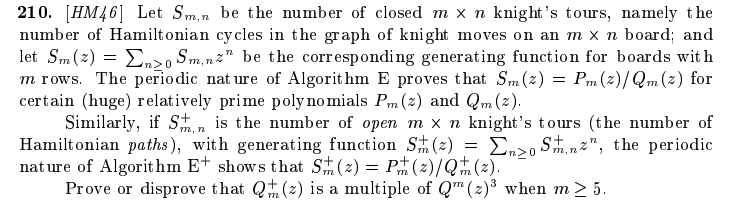
For the knight's graph on an m x n board, let S_{m,n} count closed tours
(Hamiltonian cycles) and S^+_{m,n} count open tours (Hamiltonian paths). For
fixed m these are rational generating functions in z (the variable marking the
number of columns n):
S_m(z)   = sum_{n>=0} S_{m,n}   z^n = P_m(z)   / Q_m(z),
S_m^+(z) = sum_{n>=0} S^+_{m,n} z^n = P_m^+(z) / Q_m^+(z).
Exercise 210 (Donald E. Knuth, The Art of Computer Programming, Volume 4, Fascicle 8A, rated HM46):
Prove or disprove that
Q_m^+(z)is a multiple ofQ_m(z)^3whenm >= 5.
This repository disproves it. At m = 5, Q_5^+(z) is not divisible by
Q_5(z)^3, so the universal statement is false.
How the proof works
The polynomials Q_5, Q_5^+ have degree in the thousands, so the proof never
computes them directly. Instead it works modulo the prime 101 and tracks a
single factor, 1 - 50z:
- Transfer decomposition. The open-tour transfer matrix, built with an
auxiliary vertex
infinityadjacent to every square, is block-triangularB = [[T,X,Z],[0,U,Y],[0,0,W]]ordered by the degree ofinfinity(0 -> 1 -> 2).Tis the ordinary closed-tour transfer; after bothinfinityedges are placed,Wcontracts to another copy ofT. Hence the reduced open denominator dividesdet(I - zT) det(I - zU) det(I - zW_rel)over the integers. - Visible factor. Over
F_101,1 - 50zdivides the reduced closed denominatorQ_5(certified by an explicit50-eigenvector of the closed transfer, obtained as a polynomial in the transfer applied to the terminal vector and visible from the start state). - Multiplicity bound. The algebraic multiplicity of eigenvalue
50inT (+) U (+) W_relis exactly 2 (1 + 0 + 1), certified by exact Wiedemann / Berlekamp-Massey nonsingularity certificates overF_101[t]/(t^2 - 2) = F_(101^2), together with a border-matrix argument that makes the eigenvalue algebraically simple in the relevant block. - Contradiction. If
Q_5^3 | Q_5^+, then1 - 50zwould appear with multiplicity at least3in that determinant, contradicting the certified multiplicity2. ThereforeQ_5^+is not a multiple ofQ_5^3.
The full argument is in PROOF.md.
Requirements
- a 64-bit little-endian machine;
- a C++17 compiler;
- GNU Make;
- OpenMP is optional and only parallelizes the Krylov verification; the code has a
serial fallback. On Apple clang (which rejects
-fopenmp), build withmake OMPFLAGS= all.
No external mathematical library is used.
Build
make all # or: make OMPFLAGS= all (no OpenMP, e.g. Apple clang)
Verify the claims
# 1. Independent counts: a Held-Karp enumeration on the 5x4 board, plus the first
#    closed/open transfer counts.
make sanity              # expect open 82, 864, 18784 for widths 4,5,6; closed 8 at width 6

# 2. Regenerate every state graph and reflection block from source and compare
#    byte-for-byte with the checked-in data (the generator is deterministic).
make regen-check

# 3. The visible modular factor 1-50z in the closed denominator.
make visible-check

# 4. The decisive step: exact rank / algebraic-multiplicity certificates. The
#    checker recomputes every Krylov moment from the matrices -- it does not trust
#    the stored moments -- and reruns Berlekamp-Massey.
OMP_NUM_THREADS=8 make rank-check
#    or run the six independent certificate checks in parallel:
JOBS=6 OMP_NUM_THREADS=1 scripts/verify_ranks_parallel.sh

# 5. Confirm every released file against its hash.
make hashes              # sha256sum -c SHA256SUMS
A pass on all five steps establishes that 1 - 50z divides Q_5 modulo 101, that
its multiplicity in the open-side transfer determinant is exactly two, and therefore
that Q_5^+ is not a multiple of Q_5^3.
Lean 4 verifier
This repository also includes a Lean 4 project that checks the formal contradiction and independently verifies the checked-in binary certificate files. See LEAN.md for details.
In brief, the Lean executable:
- checks SHA-256 hashes, binary magic/version fields, matrix dimensions, CSR structure, state-label tails, and FNV bindings;
- fully replays the visible-factor certificate by computing
r = g(A^2) beta, checking the76and50eigenvector equations, and comparing against the restrictedTrel_pluseigenvector; - recomputes all
2N + 32Wiedemann/Krylov moments from the actual sparse matrices for all six rank certificates when run in full mode; - reruns Berlekamp--Massey over the first
2Nstored moments and checks that the resulting full-degree connection polynomials match the stored coefficients; - builds the formal Lean theorem
KnuthFasc8aEx210.WidthFiveCertificate.not_cubic_divisibility, which proves that the certified multiplicity facts contradictQ_5(z)^3 | Q_5^+(z).
Quick Lean check:
lake build
lake build knuth_cert_check
.lake/build/bin/knuth_cert_check
Full Lean certificate-file verification:
.lake/build/bin/knuth_cert_check . all all bm
The full Lean verifier is intentionally slower than the C++ checker because it recomputes the large sparse Krylov streams in Lean.
Expected full-graph SHA-256 values (also checked by make regen-check):
f6f3c08995a607bf6217fcfe6d432a9c712b8962a0b785fe2ff03b56d808055e  data/T5.bin
847d20bc46ab8c060bfc00c49e26ab84e64d8bd4b0fe36a7915a9834be2d16ca  data/U5.bin
37c75a7aea19bd1dd885ec304c36ea165c02947d2575de829798dc03024ef5d7  data/W5.bin
Verification status
This release has been independently audited and no discrepancies were found. The checks below are reproducible from this repository:
- Hashes and regeneration. All
SHA256SUMSentries verify, andmake regen-checkrebuilds the state graphsT,U,Wand every reflection block byte-for-byte from source. - Counts vs. brute force. A separate enumeration independent of the transfer code
(Held-Karp on 5x4 via
bruteforce_5x4, plus direct backtracking for wider boards) reproduces the open counts82, 864, 18784, 622868for widths 4-7 and the closed count8at width 6. - Visible factor.
e^T A^k beta (mod 101)reproduces the closed-tour counts, confirming that the eigenvalue50lives in the genuine closed denominator (make visible-check). - Multiplicity is two. Each of the six nonsingularity / algebraic-simplicity
facts was re-confirmed by an independent Wiedemann / Berlekamp-Massey computation
over
F_(101^2)with different random preconditioners, agreeing with the checked-in certificates (make rank-check).
Regenerate the certificates
The checked-in certificates use seed 1. Generation uses randomness only to find
the data; verification of the fixed data is deterministic and exact.
make certs-regenerate # overwrites data/certs/*, then compare with sha256sum -c SHA256SUMS
Repository layout
| Path | Purpose |
|---|---|
PROOF.md | The mathematical argument, end to end |
src/transfer_generator.cpp | Frontier (broken-profile) transfer generator for T, U, W; SCCs; terminal/coreachability checks |
src/extract_blocks.cpp | Reflection decomposition into +/- blocks; exact W_rel = T_rel check; singleton checks |
src/sanity_counts.cpp | Scalar closed/open counts, including terminal endpoint choices |
src/bruteforce_5x4.cpp | Independent Held-Karp count on the 5x4 board |
src/closed_factor.cpp | Constructs the visible 50-eigenvector |
src/verify_visible.cpp | Deterministic check that 1 - 50z is visible in the closed scalar denominator |
src/wiedemann_ext.cpp | Exact certificate generator over F_(101^2) |
src/verify_rank_cert.cpp | Independent exact certificate verifier |
LEAN.md, KnuthFasc8aEx210/ | Lean 4 theorem and certificate-file verifier |
lakefile.lean, lean-toolchain | Pinned Lean/Lake project configuration |
data/, results/, SHA256SUMS | Matrices, certificates, captured outputs, and hashes |
Binary formats
All integer fields are little-endian.
KMC201— sparse CSR matrix modulo 101, followed by canonical state labels.KMV101— eigenvector and nonzero pivot.KMP101— polynomial used for the visible factor.KMW2CERT— rank certificate header, Krylov moments, and BM connection polynomial.
SHA256SUMS covers every source, matrix, and certificate in the release.
Reproducibility notes
The generator is fully deterministic -- no hash-table iteration order is allowed to
affect a saved transition list -- so make regen-check rebuilds every matrix
byte-for-byte from source. The certificate verifier reconstructs the random
preconditioners and probe vectors from a recorded seed, recomputes all 2N + 32
moments from the sparse matrix, reruns Berlekamp-Massey, and only then compares
against the stored data, so a passing run does not depend on trusting any
precomputed file.