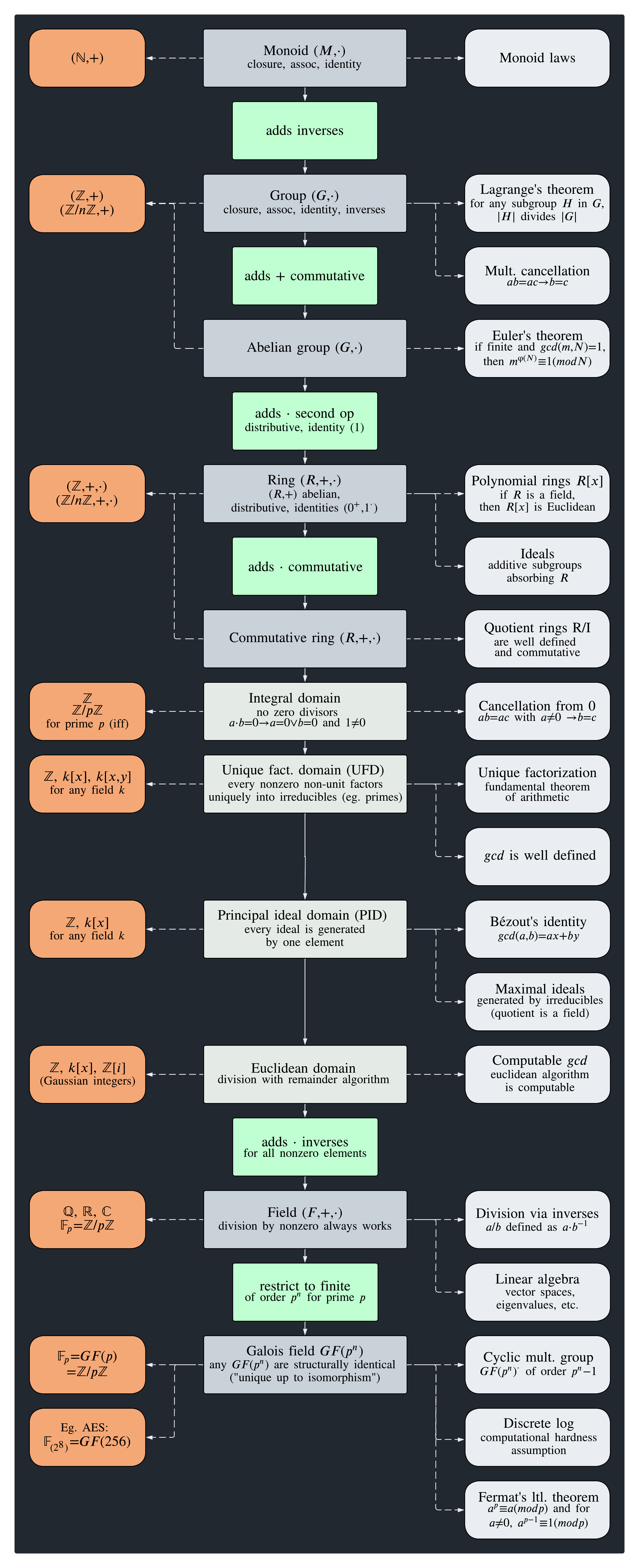
Algebra & Cryptography
A collection of Lean 4 files written as a personal study of modern algebra and its applications to cryptography. Built on top of Mathlib.
Status: heavily work in progress. Expect gaps, rough edges, and frequent rewrites; files will be added, restructured, and refined over time as the study progresses.
Layout
- Algebra: core algebraic structures
- Code
- Hamming: the [7,4,3] Hamming code; generator and parity-check matrices, codewords, syndrome decoding, single-error correction, and a worked example
- Hypergraph: hypergraph incidence matrix as a parity-check matrix, k-uniformity, minimum distance, unique syndrome decoding theorem, and the Hamming [7,4,3] code as a 4-uniform hypergraph
- ReedSolomonReedMuller: Reed-Solomon codes (univariate polynomial evaluation over GF(2ᵏ), injectivity and minimum-distance bounds, computed GF(8) demonstration) and Reed-Muller codes (multivariate polynomial evaluation on the boolean hypercube, with RM(1,2) example)
- Group
- Cyclic: cyclic groups and their connection to ℤ/nℤ
- Ring
- Polynomials: polynomial rings, working over 𝔽₃[X]
- RootsInterpolation: the roots bound (Schwartz–Zippel), interpolation, and vanishing polynomials
- Multiplicity: multiplicity of a root, the degree budget counted with multiplicity, the derivative test for repeated roots, and the characteristic-2 collapse (X − 1)²ʳ = X²ʳ − 1
- Ideals: ideals, kernels, quotients, and the prime/maximal hierarchy
- Multilinear: multivariate polynomials, the multivariate Schwartz–Zippel bound, and the multilinear extension (MLE) of boolean functions over 𝔽₂
- Field
- Galois: finite fields GF(pⁿ) and their structure
- Characteristic: the characteristic of a field; why it is prime, char-2 facts (x = −x, translation involutions), the freshman's dream, and the squaring dichotomy (2-to-1 odd vs 1-to-1 char 2)
- QuadraticResidues: squares in 𝔽ₚ, Euler's criterion, and the Legendre symbol
- RootsOfUnity: roots of unity in finite fields, primitive roots, and the connection to cyclic subgroups
- BinaryFields: GF(2) and GF(2ⁿ), boolean gates as polynomials, Freshman's dream, Frobenius, and trace map
- G8: GF(8) hand-rolled as bit triples with schoolbook multiplication, so worked examples can evaluate with decide
- Code
- Crypto: cryptographic schemes built on the above
- DiffieHellman: key exchange in a cyclic group
- Rsa: RSA correctness from Bézout and Euler's theorem
- EllipticCurves: Weierstrass curves over finite fields
- Paillier: additively homomorphic encryption, decryption correctness proven as algebra
- McEliece: code-based encryption; scrambling by S·G·P, decryption correctness from a decoder hypothesis, and a fully executable [7,4,3] Hamming code instance
- Merkle: binary hash trees and authentication paths; honest paths verify, plus a concrete tree over GF(8) showing a nonlinear hash is binding where a+b is not
- ZK
- Schnorr: sigma protocol for knowledge of a discrete log; completeness, special soundness, and honest-verifier zero-knowledge
- Sumcheck: the sumcheck protocol on the boolean hypercube; the soundness per round is read off the multivariate Schwartz–Zippel bound
- BinaryFRI: proximity testing over binary fields; additive folding via q(x) = x² + β·x, the fold chain, and the Reed-Solomon distance properties behind the proximity question
- EvalOpening: the evaluation opening p(r) = v at a point outside the committed domain, via the quotient (p − v)/(X − r); a false claim is far from every codeword of the smaller code
- Binius: the full binary-field argument for a boolean circuit, end to end on an AND gate; MLE → sumcheck → binary FRI → Merkle, with the soundness budget
- Examples: end-to-end runs that wire the pieces above together
- Sumcheck: a sumcheck run over ℤ/7ℤ with a quadratic round polynomial, where two values cannot serve as the message and the challenges land outside the interpolation nodes
- BinaryFRI: a binary FRI micro-run over GF(8) (Algebra/Field/G8.lean); a real RS [8, 4, 5] codeword of a message polynomial and two fold rounds down to a constant, with the verifier's fiber checks at each round
Build
lake build
The Mathlib revision is pinned in lakefile.toml.