
Classification of Compact Surfaces
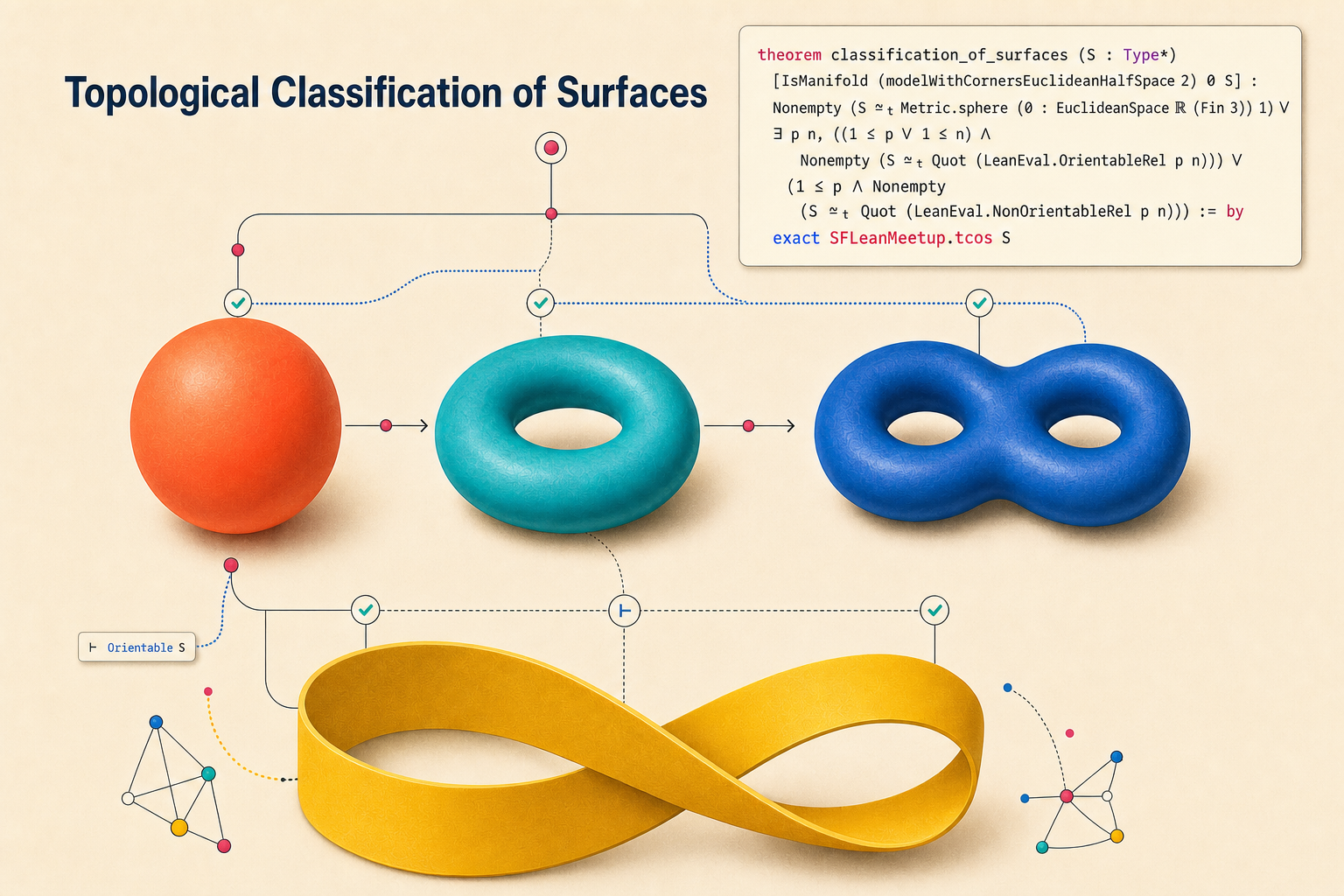
This repository contains a Lean proof of the Lean Eval challenge
topological_classification_of_surfaces and shared work toward the related
jordan_curve and schoenflies problems. Lean Eval problem
It proves that every compact connected Hausdorff topological 2-manifold with boundary is homeomorphic to the sphere, an orientable normal-form quotient, or a non-orientable normal-form quotient.
Authorship
This is a collaborative work of the SF LEAN meetup, undertaken as an exercise in autoformalization. Most of the autoformalization work was done via ChatGPT Sol, with contributions from Claude Fable and other models.
If you are in the bay area, come to the weekly meetup at the SF Mox coworking space.
Documents
ClassificationOfSurfaces/API.lean: public Lean API map and preferred code entry point.docs/ARCHITECTURE.md: proof architecture and source-file map.docs/DESIGN_DECISIONS.md: stable design choices behind the formalization.docs/AUTOFORMALIZATION_GUIDE.md: definition-faithfulness and maintenance rules.blueprint/src/content.tex: theorem-by-theorem proof blueprint.CONTRIBUTING.md: collaboration workflow.
Build
lake build
The public classification proof is complete and contains no sorry.
Lean Eval submissions
The repository is directly submittable to Lean Eval. Exact benchmark workspaces
live side by side under LeanEval/; Lean Eval discovers them by the name in
each lakefile.toml and overlays only their Submission.lean and
Submission/**/*.lean files onto pristine benchmark workspaces.
The large supporting payloads are generated from the normal source tree:
python3 port_submission.py          # refresh every ready payload
python3 port_submission.py --check  # verify that checked-in payloads are current
python3 port_submission.py --list   # show ready submissions and scaffolds
jordan_curve and topological_classification_of_surfaces are wired to complete
proofs. schoenflies has the correct workspace shape but remains a scaffold
until the full theorem is proved. See LeanEval/README.md
for the layout, local comparator commands, CI behavior, and the steps for adding
another shared source root.
Normal pull requests build only the development project. Apply the
lean-eval-submission label when a PR's generated payloads are ready for the
standalone Lean Eval freshness and comparator checks; the same workflow can also
be started manually for any revision.
Architecture
The proof is organized around the faithful finite-cyclic polygonal-realization handoff:
GeometricTriangulation.toFiniteCyclicPresentation
FiniteCyclicPresentation.PolygonalRealization
The completed Moise–Radó route produces a faithful GeometricTriangulation. Its cyclic face
presentation is homeomorphic to the geometric realization, Gallier–Xu normalization preserves the
polygonal realization, and the three canonical endpoints realize the exact Lean-Eval
representatives:
GeometricTriangulation
  → FiniteCyclicPresentation
  → NormalForm.canonicalPresentation
  → vendored Lean-Eval quotient
The final theorem classification_of_surfaces, with blueprint-facing wrapper
topological_classification_of_surfaces, is the composition of these faithful homeomorphisms.
SurfaceCellComplex now contains only finite incidence data; its former arbitrary realization
fields and compatibility aliases have been removed.
Result
- The repository builds with
lake build. - The bottom API has concrete finite combinatorial data:
SurfaceCellComplex, signed darts, oriented triangulation edges, one-face presentations, and a data-preserving triangulation-to-cell-complex conversion. - Standard example boundary words for the disk, annulus, torus, projective plane, and Mobius strip
compile as
SurfaceCellComplexvalues. - The C0 chart-boundary seam is discharged: planar no-retraction gives Brouwer's fixed-point
theorem, hence invariance of domain and an unconditional
ChartBoundaryInvariantinstance. - The Moise/PL triangulation route is complete for compact connected Eval surfaces, including surfaces with manifold boundary, and uses only the hypotheses in the Lean Eval statement.
- The geometric triangulation is faithfully identified with its finite-cyclic polygonal quotient.
- Gallier–Xu normalization reaches an admissible canonical presentation while preserving that quotient.
- The sphere, orientable, and nonorientable canonical presentations realize the exact vendored Lean-Eval representatives.
classification_of_surfacescomposes this faithful chain directly.