
Matrix multiplication: ω ≤ 9/4 over every ring

OpenAI proved ω ≤ 9/4 over the complex numbers in its
matrix multiplication preprint.
Our earlier all-fields extension
establishes the same bound over every field.
This repository extends the result to arbitrary associative unital
rings, including noncommutative rings.
The full theorem, including the trivial ring, passed compilation, axiom audit,
fresh-kernel replay, and frozen-specification Comparator with all six bundled
checkers on Lean 4.35.0-rc3. Both deliberate negative controls also passed.
The rc3 pin avoids a Challenge-rendering failure in the rc4 renderer; all 160
Lean files under lean/ are unchanged from the previously verified rc4 version. See
verification details and current status.
Both the extension's Lean proof development and the paper are AI-generated with Codex under human direction. The numerical exponent and main proof architecture are OpenAI's. This is an extension of scope, with no claim of a better numerical bound or independent human peer review.
The theorem
theorem omega_le_nine_quarters_all_rings
    (R : Type u) [Ring R] :
    Arithmetic.omega R ≤ (9 : ℝ) / 4
The substantive statement change from the prior theorem is small:
- (F : Type u) [Field F] : Arithmetic.omega F ≤ (9 : ℝ) / 4
+ (R : Type u) [Ring R] : Arithmetic.omega R ≤ (9 : ℝ) / 4
The arithmetic model has exactly seven Field → Ring substitutions.
Its gate costs, evaluation, correctness quantifiers, positive exponent slack,
and infimum definition are unchanged. Nontriviality is retained for the lower
bound 2 and boundedness of the admissible-exponent set.
For the trivial ring, one free constant-zero register supplies every output.
Every real exponent is therefore admissible. The unchanged real-valued
definition gives omega R = 0 by Mathlib's convention sInf Set.univ = 0;
the admissible set in this case has no genuine real infimum. The explicit
zero-cost program and the direct operation-count theorem avoid reliance on
that convention for the algorithmic claim.
The stronger intermediate theorem is exactRankExponent_int_le_nine_quarters:
the exponent of exact integer coefficient tensor rank is at most 9/4.
Those identities give programs over every ring, since integer constants are
central and each left-input factor stays before its right-input factor.
The direct operation-count theorem says that for every ε > 0 there is a constant C > 0 and, for every matrix size n ≥ 1, a correct program costing at most C n^(9/4 + ε) additions, subtractions and multiplications. This also includes the zero ring. It is an existence theorem for arithmetic programs; it does not establish an exact O(n^(9/4)) endpoint, an efficient uniform circuit generator, or a bit-complexity bound.
Where the bound applies
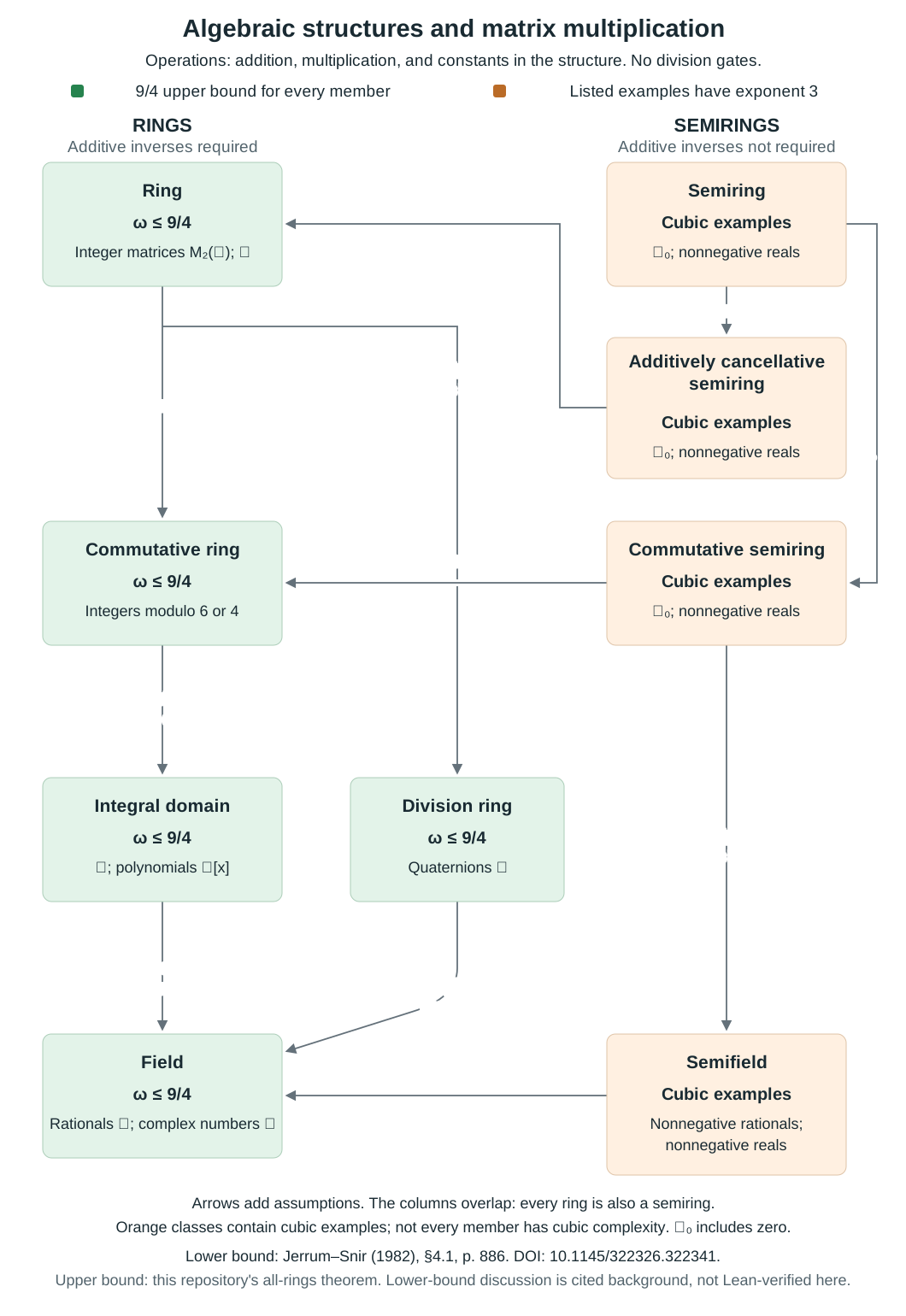
Green means the 9/4 upper bound holds throughout the class. Orange means the
class contains cubic examples, not that every member is cubic; rings are also
semirings. The comparison uses addition, multiplication and constants within
the chosen structure, with no division gates. Over rings, negative constants
simulate subtraction with constant-factor overhead.
For the nonnegative reals, matrix multiplication requires n³ multiplication
gates in this model: Jerrum and Snir (1982),
§4.1, p. 886,
DOI: 10.1145/322326.322341.
That counterexample rules out a universal semiring extension. This classical
lower bound is cited background, not formalized in this repository. See
definitions, model details and full citation
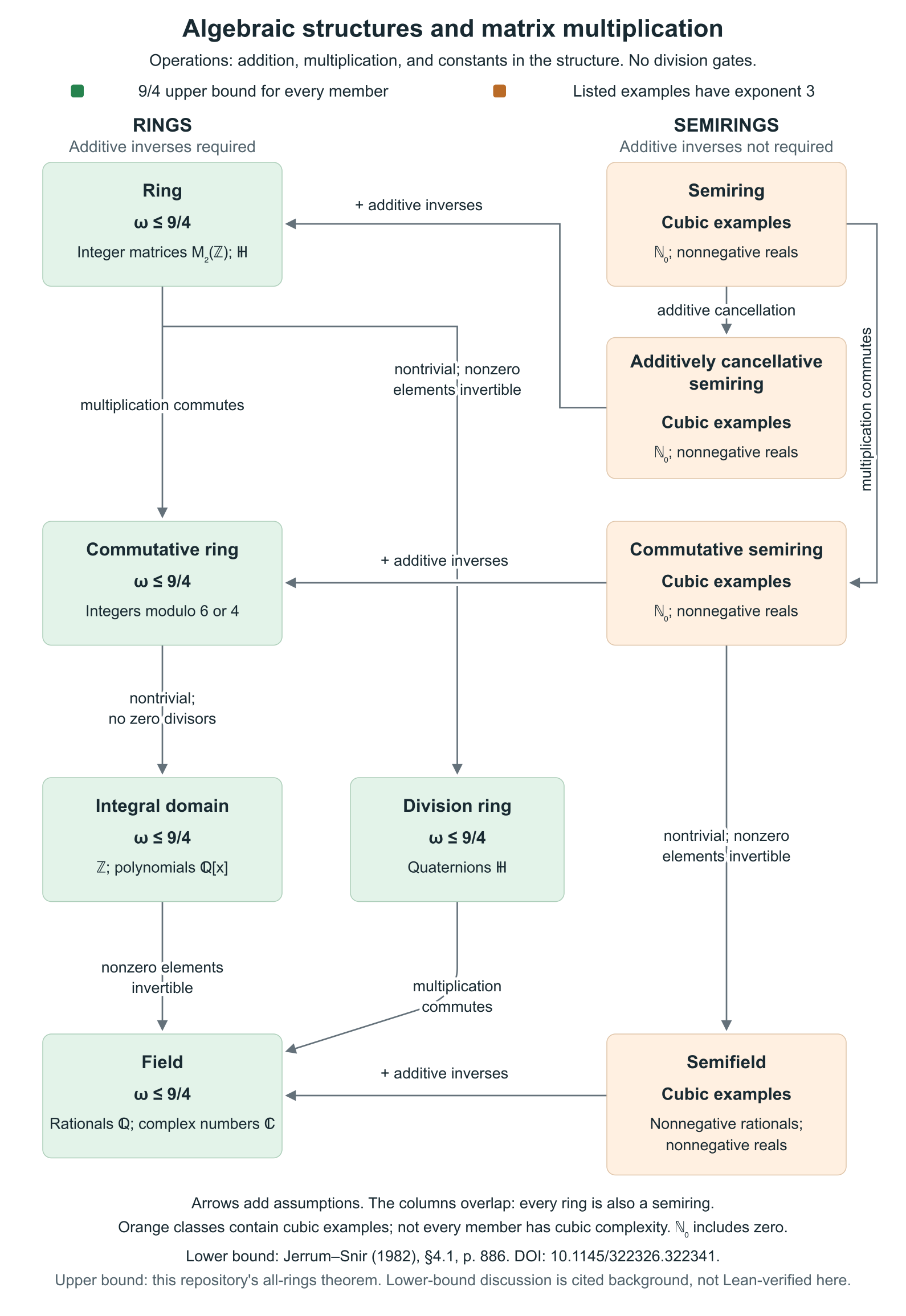
or the PNG diagram.
What the extension adds
- A suitable integral tensor spectrum, avoiding the false assumption that every nonzero integer tensor restricts to the unit tensor.
- Division-free coefficient extraction and descent through one fixed finite free integer algebra after taking powers.
- Consecutive unnormalized Fourier periods, with their scalar multipliers cancelled by Bezout before character evaluation.
- Integral convolution schemes obtained by finite-field specialization, Vandermonde adjugates, integer norms, and a finite coprime patch.
- The inherited determinant, sector and profile argument over these inputs, followed by the bridge to arbitrary ring arithmetic.
See the paper PDF, LaTeX source, and provenance. The paper has no author byline or date and is associated with its repository commit.
Citation and archival release
Version 0.1.0 is published on Zenodo:
DOI 10.5281/zenodo.23268534.
The archive preserves source snapshot
2d2cc89859d17d3143cd40c4a4b3df49801aa533,
including the Lean development, paper, verification records, Git history bundle
and checksums. Subsequent documentation and the rc3 compatibility changes are
outside that frozen release.
Use the version DOI to cite this exact archive; the
concept DOI identifies the evolving project.
CITATION.cff supplies the software citation, and .zenodo.json retains the archive metadata and attribution. The creator credit describes human direction of the project; the proof development and manuscript remain explicitly disclosed as AI-generated.
See the Zenodo release record and
Palomar submission status. Palomar runs its own
verification against a fixed public commit; the local verification receipt
does not substitute for that registry workflow.
The full Palomar mechanical preflight and registry verification passed
for the submitted rc4 snapshot, but its registry rendering stage failed.
The unchanged Challenge has since rendered locally with the unmodified rc3
renderer; see the rendering check.
The official hosted rc3 mechanical preflight also passed
for candidate commit 9d10116c89f9bdcdaccd58aacea353d4b7ae6e90, with empty report
error and warning lists. PR #6
contains the compatibility change and its receipts; subsequent receipt and
documentation commits are outside the exact snapshot checked by that workflow.
The original submission remains tied to its rc4 commit. No new submission or
registry acceptance is claimed.
Build and verify
Lean 4.35.0-rc3 and Mathlib
c55e6e786f49471c72fbddbec5415808896aec1e are pinned on the compatibility branch.
The arithmetic model and all six frozen Challenge statements are unchanged.
lake exe cache get
LEAN_NUM_THREADS=1 lake build
LEAN_NUM_THREADS=1 lake build OAI.LinearAlgebra.MatrixMultiplication.FinalAudit
python3 scripts/check-specification.py
bash scripts/check-kernel.sh
python3 scripts/check-comparator.py --trusted-local --negative-controls
The specification checker freezes the original model plus only the seven
approved typeclass substitutions. Comparator checks six statements, including
BddBelow, the lower bound, direct costs, and exact integer coefficients.
The rc3 verification receipt records
the successful full build, fresh-kernel replay and six-checker Comparator run.
The two negative controls rejected changed multiplication cost and sorry
again under rc3. The archived rc4 receipt
and earlier nontrivial-ring receipt
retain their original versions and scope.
The local Comparator command disables its build sandbox; it is not a claim
of sandboxed source-provenance verification. See audit details.
Development uses a serialized build queue on this machine:
python3 scripts/lean-queue.py submit --owner NAME Module.Name.
Only the coordinator starts worker; stop drains the current request.
Stop the worker before kernel/Comparator checks; the scripts share its lock.
The working agreements document ownership and resource limits.