
trureturing
A scientific method for AI to discover truth and find its next question.
Vision · Film · Start · Method · Examples · Truth and computation · Spacetime · Information escape · Evidence · First run · Lean source · Book · Contribute · Licensing
trureturing develops a scientific method for AI to turn gaps in knowledge into questions, test conjectures, expose limits in its representations, and return checked results to a reusable library. Autonomous research selection remains a goal to evaluate.
The name expresses true · return · Turing. Truth guides the search; verified knowledge returns as a premise for the next inquiry; computation explores the connections. We call the structure we seek the geometry of logical truth: dependencies, invariants, distinctions and the boundaries of what an observer can recover.
The project combines philosophical inquiry, theory, experiments and Lean 4 formalization. Each proof establishes its exact statement under declared assumptions. The vision and research guide connects this work to open directions.
Film

TRURETURING — Truth Is Discovered · English AI narration · Chinese and English subtitles. Download MP4 · Film source and releases.
Start your journey
Bring a question that matters to you. In an installed Claude Code or Codex with a local workspace and Git, paste this one sentence:
Help me explore https://github.com/the-omega-institute/trureturing: use an existing checkout or clone it into a new directory if needed, read AGENTS.md and README.md, then read the relevant SKILL.md under skills/ to investigate a question I care about and find a checked result or a clearly stated open question.
The agent and skills guide explains how to begin with either client and turn an exploration into a contribution.
This homepage is the tip of an iceberg. The examples offer a glimpse; the larger shape is yours to explore, following definitions, assumptions and connections with your own questions. What you find can change how you look. An epigraph for that exploration:
And if thou gaze long into an abyss, the abyss will also gaze into thee.
— Friedrich Nietzsche, Beyond Good and Evil, §146.
From questions to knowledge
Search Lean source and literature for your target. Identify missing premises, distinctions or connections; choose questions addressing them. Specify supporting and refuting outcomes before designing discriminating tests. Keep results with their assumptions; check those against your objects before reuse.
The last line of the ledger is always the first line of the next round.
Proofs supply premises; counterexamples refute claims within their stated scope. When identical readings hide different target values, no function of those readings recovers the target in both cases. Seek new observations or relations.
Evaluate research selection against stated baselines on questions excluded from method design, matching information and resources.
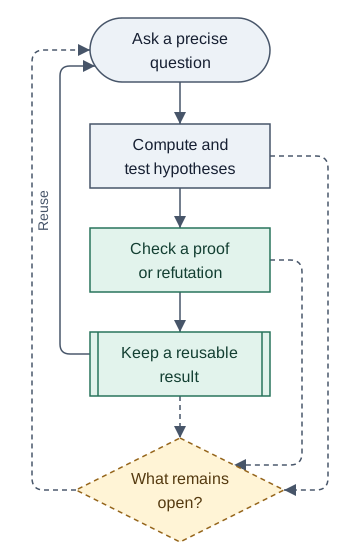
A schematic of inquiry, not runtime behavior or dependency data. Checked results return as premises; dashed returns carry unresolved questions, even without a checked result. Tests alone do not establish a theorem.
Golden integers, Fibonacci weights and Zeckendorf representations are one thread of the library; the examples below also explore conjecture refutation and limits of local observation.
Three places to look
01 · Refute a conjecture.
For positive integers n, let a(n) be the greatest integer k with (1 + 1/n)^k ≤ 2.
Greathouse conjectured for OEIS A175406 that
a(n) = floor((n + 1/2) log 2). At n = 1121626023352383, the formula gives
777451915729368, while the actual value is one less.
The Lean refutation
uses certified logarithm bounds to refute the literal universal formula.
What characterizes the inputs where it fails? Witness minimality and priority
are not claimed. Problem and sources ·
Explanation.
02 · Find what observations cannot tell you.
The local-marginal theorem
gives two-qubit states with identical reduced states on both qubits: the pure
Bell state (|00⟩+|11⟩)/√2 and the equal 00/11 mixture. An added joint
X⊗X readout has expectations 1 and 0, respectively, where X swaps
0 and 1. This separates this pair.
For finite factor dimensions m, n ≥ 1 with m × n > 1, the theorem also
proves that the correlation sector in the Hermitian tensor model is orthogonal
to the local sectors and has real dimension (m² − 1)(n² − 1). This identifies
precisely which directions the local description omits.
Explanation.
03 · Build a result that holds beyond the examples.
Write a natural number n as its unique sum of nonadjacent Fibonacci weights
F₂ = 1, F₃ = 2, F₄ = 3, …. Replace each weight Fᵢ by φⁱ, where φ is the
golden ratio, to obtain β(n). How far does this coordinate fail to preserve
addition?
deficit_three_valued proves this for
all natural inputs. For 1 + 1, β(1)=φ² and β(2)=φ³ give 2φ²−φ³=1.
The discrepancy is also the signed count of the two
lowest repeated-carry rules during digit normalization: a reusable connection
between an arithmetic algorithm and an exact bound, however large the inputs.
Definitions and carry-count theorem ·
Explanation.
Truth and computation
Our philosophical starting point is that truth is discovered, not created by the act of computing it. In this view, Dao (道), or God (神), names an encompassing network of truths and their logical relations, within which a finite observer discovers connections. This is the project's metaphysical orientation, not a theorem about the existence of God or the physical universe.
Computation constructs examples and counterexamples, searches for proofs and checks them. A verified proof extends what the library can justify and reuse. Neither this philosophical conviction nor a growing proof library establishes that one program can enumerate or decide every truth.
The dependency topology calls a set open when it contains every node reachable from its members. The recovery criterion says that, on a nonempty state space, a target admits a recovery function from an observation exactly when any two states with the same observation have the same target value. Existence alone supplies no algorithm or cost bound.
Toward holographic spacetime
We study holographic spacetime geometry by asking when partial records of time and space support reconstruction and temporal composition.
Local agreement can fail globally:
three windows on Boolean variables require x=y, y=z and x≠z. Every
overlap allows both values, yet no triple satisfies all three constraints.
The tree extension theorem assumes nonempty local record sets on a finite tree: each recorded variable's occurrences form a connected subtree, and neighbors allow exactly the same joint assignments on their full overlap. Every allowed local record extends across all recorded variables, satisfying every local constraint. Additional global constraints can exclude every extension.
Uniqueness, original-history recovery, computational cost, and reconstruction with resolution and error bounds require further results. Links to physical spacetime or holographic duality remain research questions.
Theory inputs study event archives retaining time, position, causal order and provenance; when observations preserve composition, shared sources and targets; and experimental distances defined through allowed experiments and responses. Their prose does not certify formal coverage.
Information escape
Information escape: some distinct states remain indistinguishable under chosen readouts (observation methods). Four questions guide an automated reviewer under development:
- Where did information escape? Name the objects, assumptions and observations under which distinct states remain indistinguishable.
- How is that escape addressed? Describe the added readout or relation, and show how a proof connects it to those objects and assumptions.
- What new information emerges? Identify the distinction now justified by the result and its verified connection to the readout.
- Where does information continue to escape? Exhibit a remaining indistinguishable pair, prove none remain within the stated scope, or mark the boundary open.
Mathematical comparison. Fix a catalog of registered theorem occurrences and their readouts on one shared state space. Remove one occurrence while keeping the others fixed. Its unique captures are the pairs of distinct states that were distinguishable before removal and indistinguishable afterward. The EscapePairs definitions and proofs formalize this comparison.
For a finite state space with at least two states, StructuralNovelty shows that removing an occurrence strictly increases the escape rate exactly when it has a unique capture. The rate is the fraction of ordered distinct-state pairs left indistinguishable. Zero unique capture does not mean worthlessness: another occurrence can carry the same distinction. This comparison supplies neither a universal value score nor a historical novelty judgment.
Example 02 adds X⊗X expectations to separate a locally
indistinguishable pair. Which pairs, if any, remain indistinguishable after
adding this readout?
The current declared-template binding rule issues Observe warnings that do not block admission (specification, A5.5; implementation). Other admission checks still apply. Its module selection is separate from the mathematical comparison above. The Normative Draft describes a wider design whose implementation remains incomplete.
What is proved, and what is open
Mathematical reuse rests on the statements, checked proof terms and axiom dependencies in the Lean source. The frozen ledger tracks frozen module identities. Theory prose supplies research input, and experiments supply observations within their declared scope; neither substitutes for a Lean proof. The C# harness checks repository rules, proof reports and frozen state. Independent review examines whether statements faithfully express the intended mathematics.
The book is a searchable snapshot of explanations, problem dossiers and literature notes, published by trureturing-mdbook. The formal source remains authoritative.
Two explicit boundaries live in Hearts.lean:
- O-5:
o5_independence, a zero-localization claim for the canonical golden Euler germ, has an unresolved proof body (sorry). - O-6:
o6WeilPositivityStatementdefines a Weil-positivity proposition. Defining that proposition supplies no proof of it.
These are open research obligations, not established impossibility results. This repository does not establish the Riemann hypothesis.
First run
Install elan and the
.NET SDK version specified in
global.json. Ensure lake and dotnet are on PATH;
you also need Git, Make and Bash.
elan selects Lean from lean-toolchain. Mathlib is declared in
lakefile.toml, with resolved dependencies in
lake-manifest.json. For contribution checks, add Python
3.11+ as python3; see the full prerequisites.
Clone the project, then build just the introductory module. The make entry
prepares a private Lean cache; the first run may download dependencies.
git clone https://github.com/the-omega-institute/trureturing.git
cd trureturing
make lean LEAN_TARGETS=D5.S0.Conventions.WDigits
The WDigits module directly reuses Mathlib's Zeckendorf development to encode and decode natural numbers. From that same directory, run this temporary example:
example_dir="$(mktemp -d)"
cat > "$example_dir/First.lean" <<'LEAN'
import D5.S0.Conventions.WDigits
open D5.S0.Conventions

#eval wdigits 42
#eval ((wdigits 42).map Nat.fib).sum
#check decode_wdigits
LEAN
lake env lean "$example_dir/First.lean"
rm "$example_dir/First.lean"
rmdir "$example_dir"
The two evaluations print [9, 6] and 42. The list contains Fibonacci
indices, so its weights are F₉ = 34 and F₆ = 8; it is not a list of the
weights themselves. #check displays the general decoding theorem's type.
Evaluating 42 illustrates the encoding; the theorem covers every natural number.
Read the explanation.
make help lists the repository's command entry points.
Take part
Start with one of the examples above. Reproduce it, improve its explanation, report a mismatch between prose and a statement, or explore a precise open question. Contributions in English and Chinese are welcome.
A continuing research program
The research directions specify evidence of progress for each question:
- Can AI choose questions that yield reusable knowledge?
- Which maps connect proof dependencies and observational distinctions?
- Which historical relations support reconstruction and legal composition?
The contribution guide walks you through forks, isolated
worktrees, checks and pull requests to dev.
Issues are a place
to bring a concrete question or reproducible problem.
License and foundations
The root LICENSE contains Apache-2.0. The repository's licensing specification assigns Apache-2.0 to repository-produced Lean code, CC-BY-4.0 to text, and CC0 to data. Third-party dependencies retain their upstream licenses and applicable notices.
Built on Lean and Mathlib. Classical results and upstream proofs remain credited to their sources.