

A “quantum CompCert”: a Lean 4 verified compiler from chain-complex–typed fault-tolerant programs down to a physical Clifford + measurement target.





LogicQ is a Lean 4 workspace for a verified quantum-error-correction (QEC) compilation stack. The code is organized as a tower of small languages, each with its own syntax, semantics, and checker, connected by lowering passes whose soundness theorems are kernel-checked.
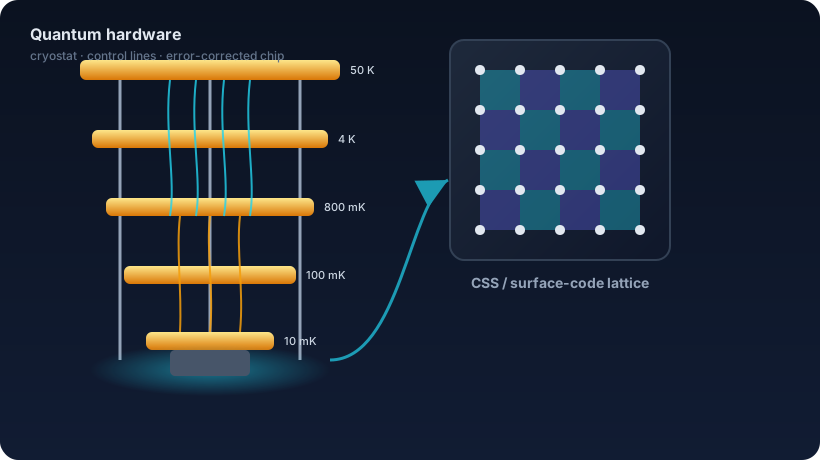
Quantum error correction protects a handful of logical qubits by spreading them across many noisy physical qubits on a chip cooled inside a dilution refrigerator (above). Turning a high-level fault-tolerant program into the exact sequence of physical Clifford gates and stabilizer measurements such a machine must run is a long, error-prone compilation. LogicQ makes every stage of that translation a typed, checked artifact — and, for the wired passes, proves that lowering preserves the intended logical action.
The stack
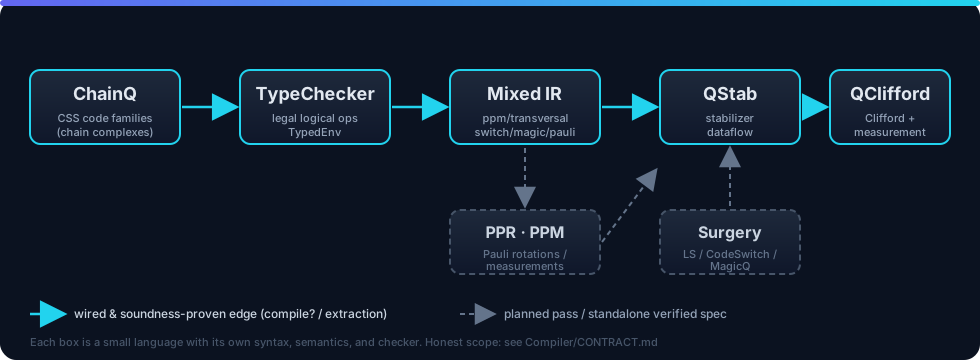
The currently wired compiler path is:
ChainQ code families → TypeChecker.TypedEnv → Compiler LogicalOp → Mixed IR
plus the physical extraction edges Mixed / PPM → QStab → QClifford.
The longer target stack — some stages exist today as standalone verified language specs, with the passes between them planned — is:
ChainQ → PPR → PPM → surgery / adapter → QStab → QClifford
Each box above is a small language with its own syntax, semantics, and checker. Solid arrows are wired edges with soundness theorems; dashed arrows are planned passes or standalone specs.
Honest scope. LogicQ is careful to separate what is proved from what is assumed or planned. Soundness theorems are
propext-clean (not advertised as “axiom-free”). Static legality, addressing, and resource discipline are proved; physical channel correctness, code distance, decoders, and fault tolerance are explicit deferred obligations — never silently assumed. The full tier-by-tier contract is in Compiler/CONTRACT.md; the design rationale is in DESIGN.md.
End-to-end LOC by layer
Here LOC means executable IR line count: one QASM instruction, one generated
ChainQ/LogicQ primitive, one MixedIR step, one QStab stabilizer instruction, or one final
QClifford gate. Declarations, comments, and barriers are excluded. The table splits QStab
into the resident-code syndrome pass and the logical-operation fragment, then shows their
total. The numbers below are checked in
Compiler/QASM/Benchmarks.lean by #guard tests, using
the currently wired structural physical path.
The main scaling signal comes from nontrivial code blocks. Bare d=1 rows are only smoke
tests: they map one logical qubit to one physical qubit, so equal counts across layers are
expected and do not demonstrate physical expansion.
| Example | Setup | QASM | LogicQ | MixedIR | Syn QStab | Logical QStab | Total QStab | QClifford | Width |
|---|---|---|---|---|---|---|---|---|---|
X; measure Z | raw CSS xCheck2 | 2 | 2 | 2 | 1 | 2 | 3 | 10 | 4 |
X; measure Z | surface d=2 | 2 | 2 | 2 | 4 | 3 | 7 | 28 | 10 |
X; measure Z | surface d=3 | 2 | 2 | 2 | 12 | 4 | 16 | 78 | 26 |
X; measure Z | surface d=4 | 2 | 2 | 2 | 24 | 5 | 29 | 154 | 50 |
X/Z; measure Z/Z | toric d=2 | 4 | 4 | 4 | 8 | 6 | 14 | 64 | 18 |
X/Z; measure Z/Z | toric d=3 | 4 | 4 | 4 | 18 | 8 | 26 | 133 | 38 |
X; measure Z | HGP [[8,1]] | 2 | 2 | 2 | 7 | 3 | 10 | 47 | 16 |
X/Z; measure Z/Z | lifted product [[15,3]] | 4 | 4 | 4 | 12 | 6 | 18 | 78 | 29 |
X/Z; measure Z/Z | toy LP [[15,2]] | 4 | 4 | 4 | 6 | 6 | 12 | 52 | 14 |
X/Z; measure Z/Z | BB [[18,4]] | 4 | 4 | 4 | 18 | 14 | 32 | 181 | 38 |
cx q[0],q[1] | surface d=2 | 1 | 1 | 1 | 8 | 5 | 13 | 49 | 18 |
cx q[0],q[1] | surface d=3 | 1 | 1 | 1 | 24 | 13 | 37 | 153 | 50 |
cx q[0],q[1] | surface d=4 | 1 | 1 | 1 | 48 | 25 | 73 | 313 | 98 |
| 3-CX chain | surface d=2, 4 blocks | 3 | 3 | 3 | 16 | 15 | 31 | 103 | 36 |
| 3-CX chain | surface d=3, 4 blocks | 3 | 3 | 3 | 48 | 39 | 87 | 319 | 100 |
| 3-CX chain | surface d=4, 4 blocks | 3 | 3 | 3 | 96 | 75 | 171 | 651 | 196 |
cat_state_n4 | bare d=1 sanity | 8 | 8 | 8 | 0 | 8 | 8 | 8 | 4 |
ghz_n78 | bare d=1 sanity | 156 | 156 | 156 | 0 | 156 | 156 | 156 | 78 |
The larger QASMBench rows below are encoded into actual Steane [[7,1,3]] CSS code
blocks, one code block per QASM virtual qubit. The compiler checks the Steane code and
logical basis, performs logical-qubit allocation, lowers H/CX/X/Z/measurement through the
encoded pipeline, prepends one stabilizer-extraction pass for every resident code block,
and extracts the resulting QStab program to QClifford. The two positive-suite programs
containing T gates (teleportation_n3, qec_en_n5) are checked negatives until magic-state
injection is wired into the physical path.
| QASMBench source | Encoded setup | QASM | LogicQ | MixedIR | Syn QStab | Logical QStab | Total QStab | QClifford | Width |
|---|---|---|---|---|---|---|---|---|---|
qrng_n4 | Steane x4 | 8 | 8 | 8 | 24 | 32 | 56 | 220 | 56 |
deutsch_n2 | Steane x2 | 7 | 7 | 7 | 12 | 37 | 49 | 131 | 28 |
iswap_n2 | Steane x2 | 11 | 11 | 11 | 12 | 65 | 77 | 159 | 28 |
cat_state_n4 | Steane x4 | 8 | 8 | 8 | 24 | 32 | 56 | 220 | 56 |
grover_n2 | Steane x2 | 18 | 18 | 18 | 12 | 114 | 126 | 208 | 28 |
lpn_n5 | Steane x5 | 16 | 16 | 16 | 30 | 82 | 112 | 317 | 70 |
hs4_n4 | Steane x4 | 32 | 32 | 32 | 24 | 200 | 224 | 388 | 56 |
bb84_n8 | Steane x8 | 43 | 43 | 43 | 48 | 205 | 253 | 645 | 120 |
qec9xz_n17 | Steane x17 | 61 | 61 | 61 | 102 | 379 | 481 | 1106 | 229 |
cat_state_n22 | Steane x22 | 44 | 44 | 44 | 132 | 176 | 308 | 1210 | 308 |
ghz_state_n23 | Steane x23 | 46 | 46 | 46 | 138 | 184 | 322 | 1265 | 322 |
bv_n14 | Steane x14 | 54 | 54 | 54 | 84 | 300 | 384 | 950 | 195 |
bv_n19 | Steane x19 | 74 | 74 | 74 | 114 | 410 | 524 | 1295 | 265 |
cat_n35 | Steane x35 | 70 | 70 | 70 | 210 | 280 | 490 | 1925 | 490 |
ghz_n40 | Steane x40 | 80 | 80 | 80 | 240 | 320 | 560 | 2200 | 560 |
bv_n30 | Steane x30 | 107 | 107 | 107 | 180 | 575 | 755 | 1977 | 419 |
cat_n65 | Steane x65 | 130 | 130 | 130 | 390 | 520 | 910 | 3575 | 910 |
ghz_n78 | Steane x78 | 156 | 156 | 156 | 468 | 624 | 1092 | 4290 | 1092 |
Additional encoded family sweeps are checked in the same file. These are not hand-counted
tables; each row is a #guard that runs the actual QASM/LogicQ/MixedIR/QStab/QClifford
pipeline:
| Family | Checked encoded setup | Positive path | Checked blockers |
|---|---|---|---|
| raw CSS | xCheck2, Steane [[7,1,3]] | readout and QASMBench no-magic subset | T/magic QASMBench cases |
| surface | distances d = 2,3,4,5 | readout, one CX, 3-CX chain | invalid d = 0,1; H remains unsupported |
| toric | distances d = 2,3,4,5 | two-logical readout | invalid d = 0,1; naive identity-incidence CX |
| HGP | open-grid (2,2), (3,2), (3,3), (4,3) | encoded readout | malformed declarations via ChainQ checks |
| lifted product | ell = 2,3,4,5 for the line-protograph fixture | two-logical readout | malformed declarations via ChainQ checks |
| BB | demo [[8,2]] plus dimension-jump [[18,2]], [[30,2]], [[54,2]] | two-logical readout | zero-logical BB variants reject allocation |
Direct MixedIR fixtures are also checked. QASM = 0 and LogicQ = 0 mean the input
starts at MixedIR, not that earlier layers compiled away:
| Example | Setup | QASM | LogicQ | MixedIR | Syn QStab | Logical QStab | Total QStab | QClifford | Width |
|---|---|---|---|---|---|---|---|---|---|
| H; S; X; CNOT; two PPMs | two bare blocks | 0 | 0 | 6 | 0 | 6 | 6 | 7 | 2 |
| batched CNOT; two Paulis; two PPMs | two bare blocks | 0 | 0 | 5 | 0 | 5 | 5 | 5 | 2 |
The current physical path includes exactly one stabilizer-extraction pass. It does not include repeated syndrome rounds, decoder logic, fault-tolerance padding, or T-gate magic injection; those remain explicit downstream obligations. A naive identity-incidence logical CX on separated toric blocks is also a checked negative today: the compiler cannot prove that incidence realizes the requested logical CNOT for that toric logical basis.
Layers at a glance
| Folder | Layer | What lives there |
|---|---|---|
| Logical | vocabulary | logical block ids and the LQubit address scheme shared by every IR |
| Physical | vocabulary | physical qubit addresses and the dense 4-letter Pauli alphabet |
| ChainQ | L_FE front-end | CSS / stabilizer code families, type-checked into proof-carrying CheckedCSSCode |
| TypeChecker | legality | accepts a logical op only when a finite GF(2)/symplectic certificate recomputes |
| Compiler | lowering | Source LogicalOp → Mixed IR (compile?) + bridges toward QStab/QClifford |
| PPR | L_PPR spec | logical Pauli-product rotations exp(i φ P) with a Mathlib denotation |
| PPM | L_PPM spec | adaptive Pauli-product measurement programs (QMeas) |
| MagicQ | magic states | cultivation + Bravyi–Kitaev 15-to-1 distillation protocol checker |
| QStab | L_QStab target | physical stabilizer-measurement classical dataflow |
| QClifford | L_QClifford target | physical Clifford gates + measurement circuits |
| CodeSwitching | reserved | source-level switching stub (real legality in TypeChecker/Judgment/Switch + Compiler/CodeSwitch) |
| LatticeSurgery | reserved | surgery-language stub (real surgery IR lives in Compiler/LS) |
| Library | references | vendored arXiv sources and notes (source-only; gitignored) |
Inside the compiler (Compiler/README.md): the
Mixed IR target and its lowering;
the verified ChainQ2Mixed front-end (path + schedule +
QGPU/qLDPC); the QStab2QClifford syndrome-extraction
pass; the OpenQASM-2 front-end and the
.lqr surface front-end; the
lattice-surgery IR; the
code-switch certificates; the
state-vector Simulator; and the worked
Demo programs.
One program at every level — in the project's BNF surface syntax
Every IR level defines its concrete syntax as a BNF grammar in its Syntax.lean, and every
level now has a real, total text parser (Parsing/Basic.lean + each layer's Parse.lean), with
by decide round-trip tests. Two keyword rules run through the surface syntax — the keywords ARE
the AST constructors: every logical instruction carries the Logical keyword, and every
Mixed IR instruction leads with its kind keyword (transversal, transversalCNOT, pauli,
ppm, magic, switch, …). Below is one minimal program — flip a qubit, then read it out — at
each level.
Logical program — every instruction carries the Logical keyword (LogicalOp; parses today
— Compiler/Mixed/Parse.lean):
Logical X q[0]                  // logical bit-flip on logical qubit 0
Logical measure q[0]↦Z -> c0    // logical Z-readout into classical bit c0
Mixed IR — each instruction leads with its kind keyword (MixedInstr; parses today —
Compiler/Mixed/Parse.lean):
pauli X q[0]                    // the X lowers to a logical Pauli applied to the carrier
ppm c0 := M q[0]↦Z              // the measurement lowers to a native PPM fragment
QASM-compatible front-ends. The same circuit is also accepted as bare-gate text by the .lqr
front-end (Compiler/Surface/Parse.lean) and OpenQASM-2
(Compiler/QASM/Parse.lean, ingesting real QASMBench circuits) — these
two compile end-to-end to Mixed IR (allocation fills in the Logical/Mixed keywords):
code q as Bare;  X q[0];  measure q[0] -> c[0]      // .lqr
qreg q[1]; creg c[1]; x q[0]; measure q[0] -> c[0]; // OpenQASM 2
-- the .lqr front-end's verified end-to-end claim (Compiler/Surface/Parse.lean):
example : compiles? "code q as Bare\nX q[0]\nmeasure q[0] -> c[0]" = true := by decide
QStab — physical dataflow. BNF: Stmt ::= QVar '=' 'Prop' PauliStr | QVar '=' 'Parity' QVar+:
c0 = Prop Z // physical Pauli measurement on the bare encoding (Z̄ = Z)
QClifford — physical Clifford + measurement circuit. BNF:
Gate ::= 'Prep0' q | 'Prep+' q | ('H'|'S'|'X'|'Z') q | 'CNOT' c t | 'CZ' a b | 'Meas' q '->' CBit | CBit ':=' 'xor' CBit* | 'If' CBit 'then' Pauli q:
X     q0
Prep0 a0                 // fresh |0⟩ ancilla
CNOT  q0 a0
Meas  a0 -> c0           // standard-Z extraction of the Z measurement
The qLDPC encoding. Swap code q as Bare for a ChainQ bivariate-bicycle declaration —
code q as BivariateBicycle { l = 3; m = 3; A = x^2*y + x^2*y^2; B = 1 + x*y^2; params = (18,2,3); },
a real parsed macro (Compiler/CodeSwitch/QLDPCPapers/ChainQProgram.lean) — and the logical
program is unchanged, but q[0]'s logical Z̄ becomes the code's high-weight operator, so the
physical levels expand. The verified end-to-end LOC table measures
this — e.g. X/Z; measure Z/Z on a toy lifted product [[15,2]] is 4 Mixed-IR ops → 12 QStab
instructions → 52 QClifford gates over 14 physical qubits, all #guard-checked.
Concrete examples for each layer
Each block shows the program in that layer's BNF grammar (defined in its Syntax.lean). Where
a real text parser exists — the .lqr surface front-end and OpenQASM — the text parses and
compiles; elsewhere the BNF is the spec and the link points to the machine form: the real,
checked Lean AST in source.
1 · Logical & Physical — the shared vocabulary
A logical qubit is Block '[' Nat ']'; the physical target uses a dense Pauli string
('I'|'X'|'Y'|'Z')+:
q[0]            // logical qubit 0 of code block q   (LQubit ::= Block '[' Nat ']')
q3              // a physical qubit (a bare number 3, or tagged q3 — as QStab/QClifford accept)
ZZI             // a dense physical Pauli string on 3 qubits   (PauliStr)
→ Logical/ · Physical/ · machine form: ⟨0,0⟩, [.Z,.Z,.I]
2 · ChainQ — declare a QEC code family
Code families are declared with the ChainQ code … as … { … } macros (real parsed surface
syntax); each elaborates and type-checks (shape, CSS commutation H_X·H_Zᵀ = 0, logical-class
membership) into a validity-carrying code:
-- real parsed macros (Compiler/CodeSwitch/QLDPCPapers/ChainQProgram.lean):
code q as BivariateBicycle { l = 3; m = 3; A = x^2*y + x^2*y^2; B = 1 + x*y^2; params = (18, 2, 3); }
code q as LiftedProduct   { ell = 8; rows = 3; cols = 4;
                            protograph = [[x^2,1,1,x^2],[1,x,x^2,x],[x^2,x,x^3,x^2]];
                            params = (200, 20, 10); }
-- surface / toric are CodeDecl kinds built as AST (no `as Surface` macro yet):
--   machine form: CodeDecl.surface 3,  CodeDecl.toric 2
→ ChainQ/SurfaceSyntax.lean · ChainQ/ · machine form: CodeDecl.bb 3 3 …, CodeDecl.liftedProduct 8 … 3 4
3 · TypeChecker — is a logical measurement legal on this code?
The distinctive judgment is a proof-carrying capability matcher, over the PPM measurement BNF
(the PPM measurement statement r ':=' 'M' MTarget): a cross-code joint measurement Z̄ ⊗ Z̄ is rejected unless an
installed adapter capability recomputes a valid merged-code certificate:
c0 := M q[0]↦Z                  // OK: native single-block measurement
c0 := M q[0]↦Z, r[0]↦Z          // REJECTED: cross-code joint Z̄⊗Z̄ with no capability
                                //  …admitted once an adapter capability is installed
→ TypeChecker/Judgment/PPM/Examples.lean · TypeChecker/ · machine form: the MTarget + Capability record
4 · Compiler / Mixed IR — the logical source and its keyword-led lowering
A Logical-prefixed source program lowers to the Mixed IR, where each instruction leads with
its kind keyword. Logical H; Logical S becomes two direct transversals (and execMixed-runs to
the same state as the ideal simulator — exact-operational equality). Both languages parse today
(Compiler/Mixed/Parse.lean):
// Logical source — every instruction carries the `Logical` keyword:
Logical H q[0]
Logical S q[0]
// → lowers to Mixed IR — every instruction leads with its kind keyword:
transversal 0 H            // MixedInstr.transversal 0 hGate2x2
transversal 0 S            // MixedInstr.transversal 0 sGate2x2
The complete Mixed IR instruction set — all eight keywords. Each colored pill below is a
MixedInstr constructor; every instruction in the IR leads with one of them:






// ── these five parse today (Compiler/Mixed/Parse.lean) ──
ppm c0 := M q[0]↦Z                  // ppm          — a native PPM/PPU fragment
transversal 0 H                     // transversal  — a local single-qubit transversal Clifford
transversalCNOT q[0] q[1] [[1]]     // transversalCNOT — inter-block incidence-checked logical CNOT
pauli X q[0]                        // pauli        — a logical Pauli applied to the carrier
magic T q[0]                        // magic        — a deferred, typed magic-state (T) obligation
// ── these three are keyword-led; their matrix / Block / cert payload stays machine-form ──
automorphism 0 [[ ..2n×2n symplectic.. ]]               // automorphism — an arbitrary symplectic logical automorphism
switch 0 repCode3 { kind := .gaugeFix, f := encF }      // switch       — a code switch (consumes/transforms block 0)
transversalCNOTBatch 0 1 [[1]] [[1]]                    // transversalCNOTBatch — a batched high-rate logical CNOT
→ Compiler/Mixed/Parse.lean · Compiler/Demo/Contract.lean · Compiler/Mixed/ · machine form: [.ppm …, .transversal …, .transversalCNOT …, .pauli …, .magic …, .automorphism …, .switch …, .transversalCNOTBatch …]
5 · ChainQ2Mixed — request ≠ realization (transversal CNOT)
The front-end separates what a logical op requests from how it is realized. A logical CNOT lowers
to the Mixed IR transversalCNOT keyword, which carries the physical incidence matrix; a
non-trivial incidence realizes a verified transversal CNOT, while a zero incidence that still claims a
logical CNOT is rejected (the lifted symplectic map would induce the identity, not the CNOT):
Logical CNOT q[0] r[0]                     // logical source
transversalCNOT q[0] r[0] [[1]]            // OK: realized as a transversal logical CNOT
transversalCNOT q[0] r[0] [[0]]            // REJECTED: zero incidence ≠ a logical CNOT
→ Compiler/Mixed/Parse.lean · Compiler/ChainQ2Mixed/Primitive.lean · Compiler/ChainQ2Mixed/ · machine form: .transversalCNOT {control, target, incidence}
6 · PPR — logical Pauli-product rotations
The L_PPR spec. BNF: Rot ::= ('+'|'-') Angle '·' PauliString, Angle ::= 'π'|'π/2'|'π/4'|'π/8',
PauliString ::= (LQubit '↦' Pauli)*. The π/8 count is the T-count — this program has T-count 2:
+π/8 · q[0]↦Z              // a T rotation
+π/4 · q[0]↦Z              // an S rotation
+π/8 · q[0]↦Z q[1]↦Z       // a two-qubit ZZ rotation
→ PPR/Syntax.lean · parses today: PPR/Parse.lean · PPR/ · machine form: ⟨⟨false, .piEighth⟩, [(⟨0,0⟩, .Z)]⟩
7 · PPM — adaptive Pauli-product measurement (QMeas)
The L_PPM measurement language. BNF (the measurement statement — the full Stmt also has
frame/discard/if/for/skip/abort): S ::= r ':=' 'M' MTarget,
MTarget ::= (LQubit '↦' PLetter)* — a one- or two-body logical observable (the natively
lattice-surgery-realizable alphabet). a is an ancilla code block:
c0 := M q[0]↦Z, a[0]↦X     // OK: a two-body joint observable
c1 := M q[0]↦X             // OK: a one-body observable
c2 := M q[0]↦Z, q[0]↦X     // REJECTED: a repeated qubit
→ PPM/Syntax.lean · parses today: PPM/Parse.lean · PPM/ · machine form: [(dataQ 0,.Z),(ancQ 0,.X)]
8 · Code switching — a transparent cross-code coercion
Code switching has no surface grammar — it is a checked certificate (a kind + a symplectic map
f). Encoding a bare qubit into the [[3,1,1]] repetition code preserves the logical
operators (it induces X̄ = XXX, Z̄ = Z₀); a degenerate all-zero map is rejected:
-- machine form: the SwitchProtocolCert value
{ kind := .gaugeFix, f := [[true,true,true,false,false,false],   -- X̄ ↦ XXX
                           [false,false,false,true,false,false]] }  -- Z̄ ↦ Z₀   (OK)
{ kind := .gaugeFix, f := zeroMat 2 6 }                            -- REJECTED: zero map
→ TypeChecker/Judgment/Switch/Examples.lean · Compiler/CodeSwitch/ · machine form: {kind := .gaugeFix, f := [[…]]}
9 · MagicQ — magic-state protocols
A magic-state protocol is a list of ProtocolOps (rendered top-to-bottom below; each line leads
with its op keyword — the discriminating constructor). The colored pills are the protocol-op
keyword set:








(assumeLogicalCheck is an assumption marker — it records a check the type system can't yet prove,
e.g. the non-Pauli H_XY, as an explicit deferred obligation — not a computational primitive.)
Magic-state cultivation (Gidney–Shutty–Jones, 2409.17595) — a
live-carrier protocol that grows one cheap T state through inject → check → grow → stabilize →
escape, threading a single carrier 0. The non-Pauli H_XY double-check, the growth fault
distance, and the escape decoder gap stay explicit deferred obligations, never claimed proven:
-- the cultivate_T Protocol value (MagicQ/Library/Cultivation.lean), default spec d1=5, d2=15:
inject                 T -> carrier 0  in ColorCode(3)                 -- unitary injection of encoded |T⟩
assumeLogicalCheck     carrier 0  H_XY  @ "double-check"               -- non-Pauli (X+Y)/√2 T-check (DEFERRED)
postselect             all-detectors                                  -- early-stage FULL postselection
grow                   carrier 0 -> ColorCode(d1=5)   faultDistance 5 @ "grow.bell-boundary"
stabilize              carrier 0  superdense × 3       @ "stabilize.superdense"
graft                  carrier 0 -> Grafted(d2=15)    codeDistance 15 @ "escape.graft"
stabilize              carrier 0  rounds 5             @ "escape.idle-grafted"     -- r1 grafted-code rounds
transitionToMatchable  carrier 0 -> Matchable(d2=15)  codeDistance 15 @ "escape.transition"
stabilize              carrier 0  rounds 5             @ "escape.idle-matchable"   -- r2 matchable rounds
postselect             detectors @ "escape.transition"
postselect             decoderGap "gap ≥ Δ"                            -- kept iff decoder gap ≥ threshold (DEFERRED)
output                 resource 0                                      -- cultivated |T⟩: faultDistance ≥ 5, codeDistance 15
→ MagicQ/Library/Cultivation.lean · MagicQ/ · machine form: the cultivateT / defaultT Protocol value
Standard 15-to-1 distillation (15 T inputs → one output) — now a library composition of
primitives, not a single op. 15-to-1 is inject ×15 → measureSyndrome → postselect → output, where
measureSyndrome is the generic syndrome-measure primitive (the "exactly 15" is a property of
this protocol, not of the primitive). The non-Pauli Bravyi–Kitaev A-type η-syndrome decoding stays
a deferred obligation:
-- the rm15_to_1 Protocol value (MagicQ/Library/ReedMuller15.lean):
inject          t[0..14] : T          -- 15 supplied noisy T inputs (15× inject)
measureSyndrome t[0..14] -> t : RM15  -- generic primitive: measure the RM-15 η syndrome, project out the T
postselect      η == 0                -- keep iff the A-type syndrome η = 0   (η decoding deferred)
output          t
→ MagicQ/Tests.lean · MagicQ/ · machine form: the rm15_to_1 Protocol value
10 · QStab — physical stabilizer-measurement dataflow
The L_QStab target. BNF: Stmt ::= QVar '=' 'Prop' Sched? PauliStr | QVar '=' 'Parity' QVar+ —
an SSA-style dataflow of physical Pauli measurements and classical parities (syndrome detectors
plus a logical readout):
c0 = Prop ZZI            -- physical stabilizer measurement
c1 = Prop IZZ
c2 = Prop ZZI
d0 = Parity c0 c2        -- syndrome detector
c3 = Prop IZZ
d1 = Parity c1 c3        -- syndrome detector
c4 = Prop ZZZ            -- logical Z
o0 = Parity c4           -- logical output
→ QStab/Syntax.lean · parses today: QStab/Parse.lean · QStab/ · machine form: [.prop …, .parity …]
11 · QClifford — the physical Clifford + measurement target
The terminal L_QClifford IR. BNF: Gate ::= 'Prep0' q | 'Prep+' q | ('H'|'S'|'X'|'Z') q | 'CNOT' c t | 'CZ' a b | 'Meas' q '->' CBit | CBit ':=' 'xor' CBit* | 'If' CBit 'then' Pauli q. E.g. CNOT(0,1) realized from a CZ:
H    q1                  -- CNOT q0, q1  =  H · CZ · H
CZ   q0 q1
H    q1
→ QClifford/Syntax.lean · parses today: QClifford/Parse.lean · QClifford/ · machine form: [.H 1, .CZ 0 1, .H 1]
12 · QStab → QClifford — the syndrome-extraction pass
Each physical stabilizer measurement is extracted by a chosen scheme (standard / destructive /
Shor / Knill / flag). A standard-Z measurement of ZZ on data qubits {0,1} extracts to this
QClifford circuit:
Prep0 q3                 -- fresh |0⟩ ancilla, physical qubit 3
CNOT  q1 q3
CNOT  q0 q3
Meas  q3 -> c7           -- one measurement into result var 7
→ Compiler/QStab2QClifford/Basic.lean · Compiler/QStab2QClifford/ · machine form: [.prepZero 3, .CNOT 1 3, .CNOT 0 3, .meas 3 7]
Public imports
The repository root intentionally has no .lean files. Import public layers through their
folder-owned entrypoints:
import LogicQ.Basic        -- umbrella over the whole workspace
import ChainQ.Basic        -- front-end code type system
import TypeChecker.Basic   -- legality checker + soundness
import Compiler.Basic      -- Source LogicalOp → Mixed IR (the wired compiler)
import PPR.Basic           -- Pauli-product rotations (spec)
import PPM.Basic           -- adaptive Pauli-product measurement (spec)
import MagicQ.Basic        -- magic-state protocol checker
import QStab.Basic         -- physical stabilizer dataflow (spec)
import QClifford.Basic     -- physical Clifford target (spec)
Each source folder has its own README with the local syntax, semantic rule, and small examples.
Build
lake build
lake build LogicQ.Basic ChainQ.Basic TypeChecker.Basic Compiler.Basic
The project uses Lean v4.29.1 and Mathlib v4.29.1. Most of the stack is Mathlib-free
(the front-end type system, PPM, QStab, and QClifford are pure Bool/List/Nat); Mathlib
enters only for the analytic PPR denotation (the complex-matrix meaning of exp(i φ P)).
License
MIT © 2026 John ye.